Remembering Sami: What Love Looks Like in the Long Goodbye
A story detailing the struggle of caring for a chronically ill and dying partner while managing life as an autistic, queer person of color in healthcare, and the loss that followed.
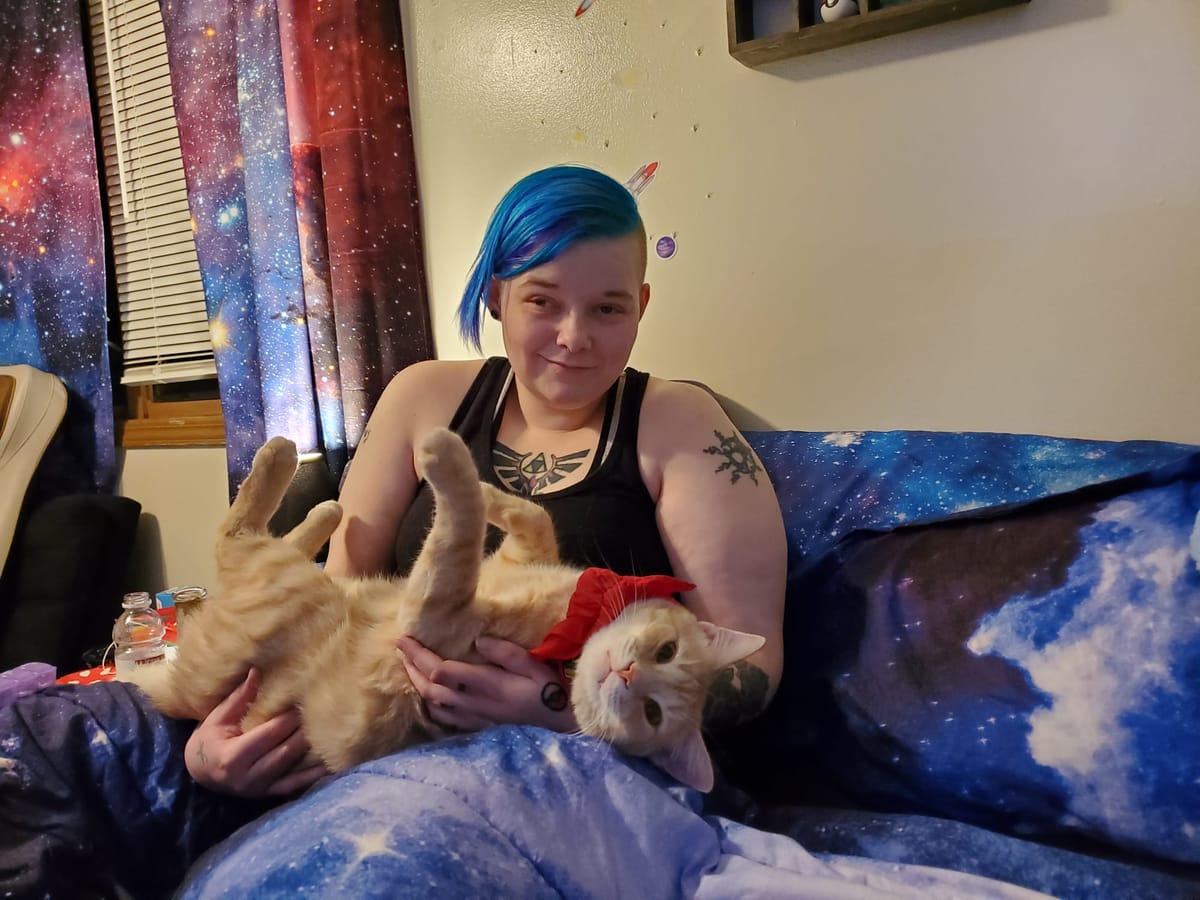
In loving memory of my first wife, even if she was not legally recognized as such. I am lucky to have been deeply loved, not once in my life, but twice.
Meeting Sami
This is the longest story I will directly publish to my blog, because I believe cutting any of it out also cuts out relevant back story and I don't want it contained to a Google Doc. While I intentionally keep most of my articles around 10 minutes or less in terms of read time, this entry is longer. I know that many readers may not make it to the end of this one.
I met Sami while studying for my first degree. I find it appropriate that I start this entry with a brief background into my life and how I started college.
When I was 19, I enrolled at Indiana University's satellite campus located in the small town of Kokomo, Indiana. It was the very end of 2014 leading into Spring 2015. The classes at IUK were small in size, but the quality of education was excellent. It felt like the individual interaction awarded to private school students at a fraction of the cost.
After my mother's death when I was 12, I had been kept truant for most of my life by my father who got away with this by "home-schooling" me, moving me completely out of the country as a teen, and sending me to high school overseas for a year at a neighbor's insistence that I get the chance to attend school at all. My siblings visited from time to time during a break in their own University education, for a total of what accumulated to maybe 4 months over the course of nearly 4 years.
My father signed me up for a few online classes as a teen. My passion was English, and I was tutored in English for a while by an American teacher who taught at the high school I attended in India. Similar to many queer teens, it was an English teacher who treated me like any other teen in need of support who I felt I could confide in.
I started college with high school basics in Math, Biology, and English. I mostly received A and B grades for my online classes and for the class that I took seriously the year I attended high school in India. However, my SAT scores were abysmal as a result of being kept isolated at home and given limited access to education or the outside world.
We moved back to the U.S. shortly before my 18th birthday, staying with my eldest brother in Champaign, Illinois. I did not know the town at all and was highly dependent on my father by his own design, having never been let out of the flat on my own while living in India. I had to relearn street signs and pedestrian rules. After a few brief months of a stressful experience with racism and ableism at a high school in Indiana while staying with two of my brothers, I kept to myself.
We were still living in Champaign when I started college. My father had ensured that I did not know how to drive and prevented my siblings from taking me to even test for my permit into my 20s. He actively prevented me from getting a job so that I would not leave his grasp or meet anyone who could lead me into living a more independent life away from him. My older siblings stayed meek and refused to challenge him. While unable to obtain resources of my own, I had no choice but to also stay obedient. I had to fawn and fit into my father's pocket to survive.
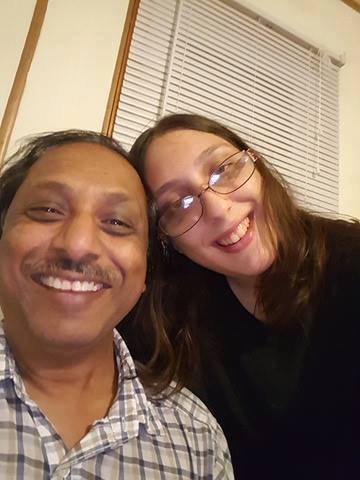
Intergenerational family systems are the norm in India. Many Indian parents live with their oldest son, who is expected to care for them in their old age, though in practice the responsibility often falls onto women.
Outside of my eldest brother, my other brothers were not self-sufficient. I realized that my father was building me up as his back-up plan. I knew that I had to lean into whatever support my father offered if I wanted to make it out of his control.
This meant that he drove me nearly four hours away to class twice a week, rather than give up any control over me. An act he used to showcase proof that he was "a loving father" but which required me to be up and ready to go by four in the morning, adding to my exhaustion as a student. It would be years before I could start to fight against his obsessive control and force my own independence.
IU Kokomo gave me a chance; I had a lot of catching up to do. Catch up I did - very fast, repeatedly making the Dean's list and going on to obtain two Bachelor's, a master's, and several certificates before eventually moving on to a second master's through Johns Hopkins.
I spent most of my freshman year in Kokomo engaged with the material and eager to make up for all the time I lost as a result of my father keeping me home and medicated on benzos as a young teen. Schedule H medication that my father pushed therapists in India to put me on, using the fact that I was grieving the loss of my mother while also rebelling against his helicopter parenting as a means to convince them.
Orange-flavored, dissolving tablets, stamped with smiley faces. At 14, these pills presented themselves as a new escape for me and led to my first attempt to end my life by overdosing. By 15, I was reliant on them.
He kept me on these drugs long past the time he had provider approval for, despite one attempt on my life and proof that I had developed a dependency on them at just 15. He did so, despite countless mothers and multiple doctors in India telling him that my deep depression and moodiness was to be expected after a major death at such a young age, combined with the fact that I was navigating my teenage years bone-achingly lonely and bored out of my mind at home as a teen with undiagnosed ADHD.
I had to work extra hard in college to make up for all the time I lost being kept isolated in an apartment and medicated until I was somewhat docile. As a result of my hard work during my first year in college, I was able to transfer to IUPUI in Indianapolis for my sophomore year where I was later nominated for IUPUI's Top 100 by a Philosophy professor. My father convinced me this was a meaningless "nothing recognition" and to let it go.
While at IUK, I started building up the social skills that had been deliberately beaten out of me by my father at every sign of growing independence and social acceptance. As a teen, whenever I had been included in a friend group, or invited out by friends, I was not permitted to go.
He was afraid of losing control over me, and afraid that I would tell other people his shortcomings as a father. There was no means by which I could reasonably sneak out, either. We lived 4 stories up in India and the windows had thick iron bars to deter thieves and suicide attempts. The entrance to our building was gated, and my father was friends with the watchguard.
Any sign of social rejection while I reintegrated into society and my father would act as a worm in my ear, convincing me that I would always be rejected by society and that I would never belong or amount to anything unless I obeyed him. I had no choice but to stay quiet and obedient. I had to fawn and fit into my father's pocket to survive. I let him convince me that I needed him to survive.
I made friends with my classmates on campus at IUK, it was easier to do in a diverse pocket of a smaller town but since I could not spend time with them outside of class, my interactions were limited. Despite this, I restarted IUK's queer student organization, Spectrum, with the help of faculty.
I recruited members and acted as club president for a short while. At the time, we were just called the Gay-Straight Alliance at IUK. In my spare time, I created a lot of art and played a lot of video games between classes to escape the fact that I had to go home nearly four hours away, trapped in a car with my father.
My father would pick fights with me and resort to verbal abuse to stay awake on long drives that he insisted on. I kept my headphones in as much as I could. Once at my brother's house, I would once again be trapped with my father. Like most of my older siblings, I spent the majority of my time self-isolating in my own room (something I did not even have until I was 19).
I was stuck forming connections online to escape my father's control. One of the games I played to pass the time was Pokémon. This was shortly before the release of Pokémon Go, which gave me another excuse to leave the house. Around this time, I joined a Pokémon group on Facebook that had thousands of people from across America as members.
I was scrolling one day when I spotted a young woman getting bullied for her short blue hair in the comments. She had corrected a male gamer on something or the other and the insults had begun. Being me, I hopped in to cuss him out. She loved gaming, and she looked cute and gay.
I clicked on her profile and found that she was in fact gay, located in Kokomo, and just a few years older than me! I took a chance and sent her a direct message. Keep in mind this was 2016, DMs were called PMs, and FB was still used by young people and not just your aunt who wants updates on your life every six months.
We started video-calling, chatting and gaming together often. Eventually, we started meeting up on campus.
That was how I met Sami.

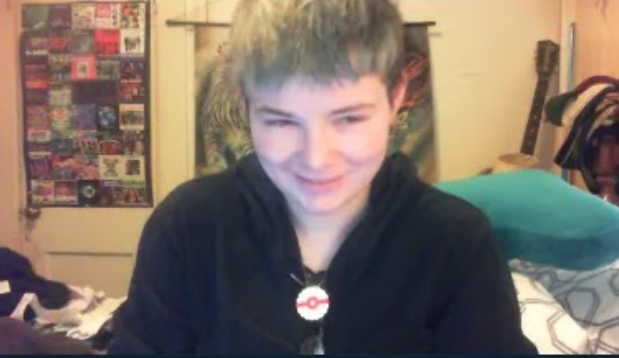
Sami, Fierce and Bright
Sami was warm, intelligent, and witty. She had the best jokes, was simultaneously a carefree and deeply caring person, and she had the prettiest blue eyes I had ever seen. Though she had to make the difficult choice to drop out of high school at a young age to care for her mother, her writing was very clearly at the level of many college undergraduates and deeply expressive. Over time spent talking and meeting up, we developed a deep connection. She was one of the first people to say anything to defend me from my father's narcissistic abuse and emotionally incestuous attachment to me.
She was one of few people since my mother had passed to make an attempt to see me for who I am and really spend time getting to know me. A fast-witted, light-hearted stoner with a mischievous glint in her eye and plenty of risky adventure stories to keep me enthralled. "And then what happened?" I just had to know.
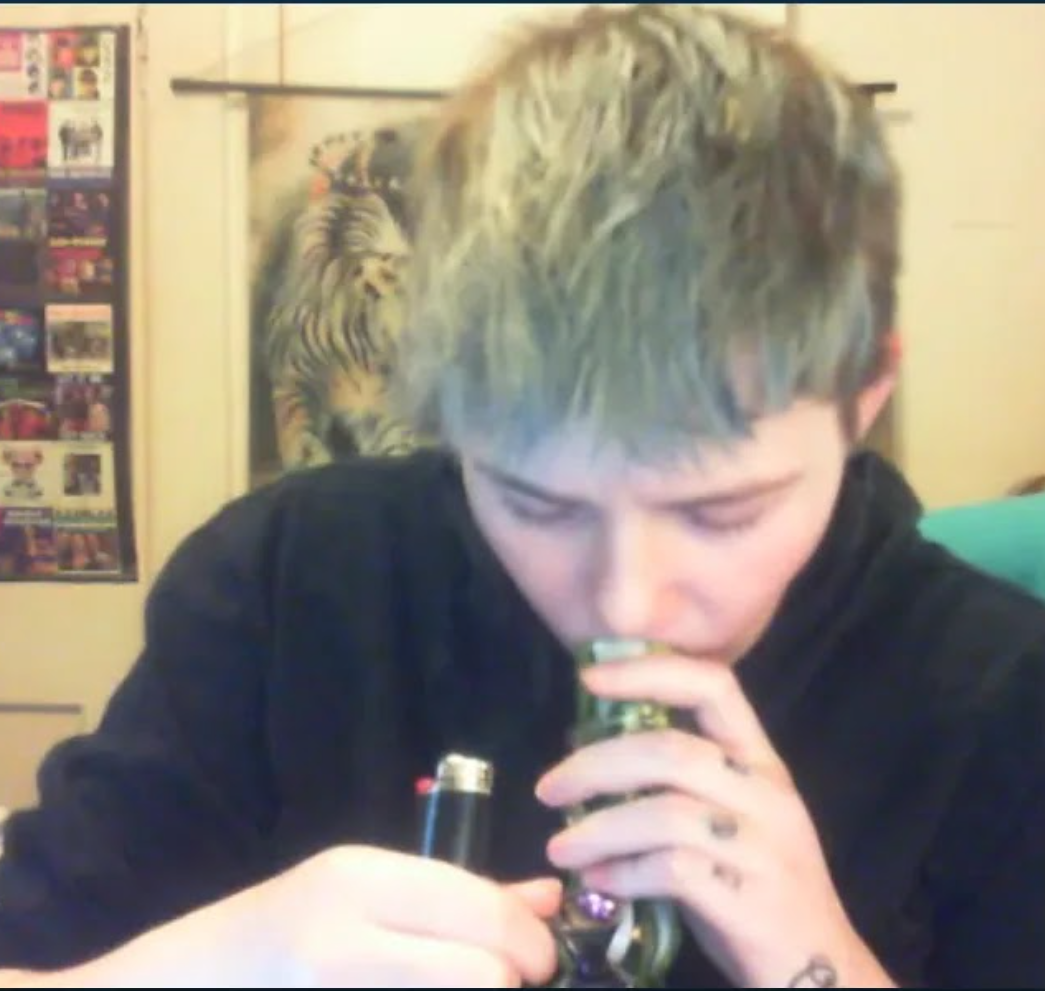
Sami made it known how much she believed in me and how she knew I was capable of growth. She took every opportunity to praise me when I worked hard to accomplish anything. This act of someone building me up was something very foreign to me after my father spent years tearing me down to fit neatly inside of his control.
His interactions with me relied on shame, coercion, and physical and emotional abuse unless I fawned and praised him and allowed him to emotionally lean on me as a strange stand-in for my mother. If he couldn't get me to "understand him" he would simply resort to calling me stupid, slow, or useless.
Confusingly, any high performance in college he would acknowledge as being simply something he expected of me as his offspring. In contrast, Sami's endless support, encouragement, and words of affirmation even when I could not perform to a high standard, felt like a healing breath of fresh air.
Sami was the first person since losing my mother to convince me of my own self-worth. She was supportive and street-smart, and she became my first life partner during a time when gay marriage had only just been legalized across America.
My father didn't approve. Sami was both white and alternative - tatted up and pierced (some of which she had even done herself). She was one of the people he would have described as "trailer park trash" when we were growing up. Ironic, as we grew up in poverty until I was around 10 due to my father's poor choices. Even more ironic, was the fact that my father had chosen a white, ex-Amish woman as his wife and she had a limited education when she married my father.
At first, I hid the fact that Sami and I we were dating from my father, but despite Sami being "the girl from the other side of the tracks" he enjoyed having another female person around he could info-dump on who was not me. I utilized what information he had to try to find Sami better care. Sami and I grew close very fast, and we were engaged within two years.
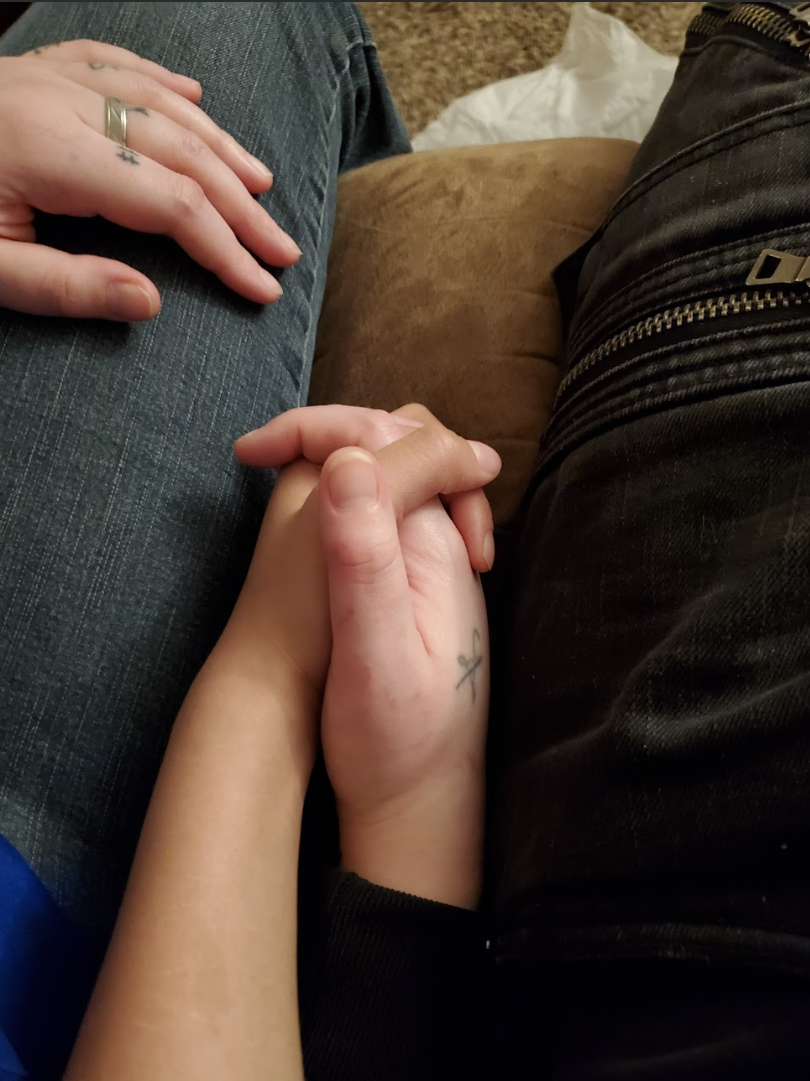
Sami had a hard life, growing up in poverty and raised by her father who won custody over her and her older brother because her mother was an absent alcoholic. Her own father later turned extremely verbally abusive and exploitative of his daughter. She had a horrible ex-boyfriend, a former marine who subjected her to his physical and sexual abuse. Sami dealt with lasting PTSD and nerve damage as a result of his abuse. She understood my grief when it came to loss, as she had lost loved ones herself. Despite everything she had been through, Sami was bubbly and sweet. Generous with her kindness.
It was because she was so resilient that I did not know Sami was chronically ill for the first three months of our relationship. She hid it from me and would vanish for days because she would be hospitalized at times. She was surprised when, each time she vanished, I would keep reaching out to her to check on her. Astonished that I hadn't ghosted her or left her yet.
She spoke softly and kindly to me and made it known that she believed in me when, for the first time in my life, I spoke all of my dreams aloud. That was enough for her to have my undying love and support.
She called me her BluJay. Blue Jays have been said to represent protection, boldness, and truth. With Sami, everything had a deeper meaning.
I had been pathed into the field of healthcare by my father. My sister and mother had chosen areas within healthcare and in my father's mind, so should I, while his sons were encouraged to pursue computer science, mathematics, and engineering. I wanted to study Psychology as my first passion like my mother eventually had.
However, as is typical in Asian households, my father discouraged anything outside of STEM and often said I was "too stupid" for the math required to pursue Computer Science. I knew that I would not have the opportunity to study if I refused his choice for me and could be perpetually dependent on him if I chose otherwise.
I made peace with his choice for me by aiming to attend medical school to become a gastroenterologist so that I could pour myself into researching a cure for my partner, Sami. It was a goal I knew that I could aspire to, and one that allowed me, at times, to envision a life past my 20s. It all got cut short.
By the time I had finished my undergraduate degree and my clinical program that would enable me to work independently, Sami's health had deteriorated even further and the friend that helped care for her in Indiana had passed away.
Sami, The Fighter
Sami was diagnosed with Diabetic Gastroparesis a few short years before I met her, and also dealt with the mental trauma that it, combined with the hardship she had long endured, caused. In my opinion, the condition was likely the result of growing up with limited access to healthcare, leading Sami to go undiagnosed as a Type 1 Diabetic for years, having nobody to teach her as a child how to check or regulate her sugars. Combined with the nerve damage resulting from the high sugars and physical and sexual abuse from her ex, this disorder made itself known.
To complicate matters further, Sami also suffered from PCOS and Endometriosis, both debilitating conditions on their own. This exacerbated her condition even further and led to more frequent flares.
According to her friends, Sami was frequently the one who showed up for everyone. From friends to romantic partners to family. She even dropped out of high school to support her mother who was largely absent from her life. Her mother later no-showed at her daughter's own memorial when Sami passed.
Sami often worked multiple jobs to care for others, but she was left with almost no support as her illness slowly took over her life. Most of my days outside of class were spent body-doubling with Sami on video. I appreciated the company while I studied, and she appreciated the care.
I would sleep on video with her, gently waking her up when she would start whimpering "no" in her sleep from nightmares of her ex's abuse. If I had any financial aid left for myself after my father drained my bank account, I would buy the best massager I could afford for her so she could set it up on a couch and use it for pain relief, replacing them for her when they would eventually stop working from constant use.
I would often buy any textbooks I needed for class secondhand, so I had more funds to spend on Sami's care. I didn't need anything fancy. All I needed was the one person who consistently believed in me to be alive. I needed Sami as much as she needed me.
Her father was known for choosing to sleep through her screams, so I would call the one friend still present in her life when she needed to go to the ER. This friend later passed away of cancer, leaving her with nobody in Kokomo who could really help care for her.
Her condition being a rare disorder already made it difficult for her to manage, and such a small town offered limited resources. Worse flares would lead to her being driven over an hour to a hospital in Indianapolis once she could be stabilized. Gastroparesis mainly affects women and female people living in poverty. There was, and still is, no cure and limited research.
I would stay on video with Sami in the ER during her flares because she would routinely experience abuse from the medical staff in Kokomo who assumed she was a drug-seeker because of her alternative appearance, limited income, and chronic pain. She experienced abuse at times from providers while receiving treatment at many facilities, but more frequently at Community Howard Regional Health, whose staff were known at the time for being abusive towards patients.
Howard County is highlighted as having experienced an Opioid crisis. The prejudice held by medical staff towards those living and struggling with active addiction meant that Sami was often left to suffer in extreme pain as someone with a rare disorder.
Sami could count on me to speak up for her when she could not, as she was frequently unable to do so during her flares. They were intense and left her unable to speak. She was, more often than not, screaming or moaning in pain, begging for help, and left crying and whimpering on her own.
At times, Sami would scream for "mommy" or "daddy" because the level of extreme pain she was in led to her regressing and reverting to her most basic instinct. She would frequently not remember these episodes once she recovered. I was 20 and rapidly overcame my social anxiety by being ready to step up at a moment's notice.
Staff would complain that Sami was "not nice to them", but she could barely speak other than to beg for help. Many nurses would often grow angry and insult her when they would ask her question after question and all she could do was cry, or rarely, snap at them while disoriented from the pain. She did not understand their growing frustration with her.
Her screams will never leave my mind. They are engraved in my memory along with the way that she would repeatedly apologize to anyone who would hear her. Unless you know someone with complicated gastroparesis who has reached the height of a flare, it is hard to describe to anyone. I can still hear her sobbing if I close my eyes and think of her.
Sadly, she would wait to go to the ER because of the abuse and mistreatment she experienced at the hands of medical staff. As a result, Sami would be severely dehydrated, disoriented, and often vomiting blood by the time she got there. If she peed herself from the pain or lost control of her functioning entirely, staff would react with disgust and lash out in anger at her, berating and insulting her.
Sami was often loosely dressed, because the only thing that would help her manage her chronic pain, apart from weed which isn't legal in Indiana, were long, hot baths. She also experienced intense hot flashes from her PCOS. All of this during a flare up meant that at times she would be partially naked in her room in the ER and it was often female nurses who would react with disgust and insult her.
This led to me speaking up frequently. I let the medical team in charge of her care know that Sami was not alone and explained Sami's condition, filling them in on the fact that she was often not fully aware of her surroundings. I would explain the care she needed.
Once medical staff knew she was being observed, they would switch to being kinder, except for the rare occasion where they would move, turn off, or confiscate her phone even when Sami had her video switched off. Leaving me unable to assist until I heard from Sami, if I heard from her at all, and worried out of my mind given the touch-and-go nature of her illness,
Sami was usually unable to articulate her pain between vomiting and begging for help and the staff would yell at her, chastising her for "being difficult" and refuse her treatment. They might offer her anti-nausea meds that worked for a limited time and send her home, still severely dehydrated and sometimes even without IV fluids. She couldn't keep anything down so within a few hours, she would be back in the ER in even worse condition than before.
This led to her being admitted for days to another hospital in the city that was better equipped to handle her care. When she was discharged from her stay, she would be exhausted and sleep for days to recover. Her body would be covered in bruises from the numerous attempts to draw her blood to send for testing.
At one point, the number of stick attempts reached around 40. Providers frequently had to rely on a Vein Viewer or ultrasound due to the advanced state of dehydration Sami was often in from waiting to go to the ER out of a justified fear of medical mistreatment.
Medical staff would at times use Sami as practice for newer providers who needed to gain experience with patients who were "tough sticks", resulting in Sami being used as a practice dummy of sorts while she was already in extreme pain and in need of life-saving care.
It was also hard to educate providers who had never heard about gastroparesis and mistook her condition for cannabinoid hyperemesis (CHS) given the similar symptoms despite it being ruled out numerous times.
I was only a health science student at the time, but I knew that the harsh reactions of medical staff were deeply misguided and entitled. The meme you see lately about mean girls in high school becoming incompetent nurses who marry cops had been proving itself true. Though there are many caring and wonderful nurses out there, encountering the latter during Sami's care was rare.
I maintain that you should not be a provider if you aren't prepared to see and handle it all in a crisis. These providers were not dealing from abuse from a patient; they were dealing with a seriously ill and dying patient experiencing chronic pain that morphine would barely touch. More often than not, Sami could hardly speak at all outside of begging for help while staff asked her 20 questions she needed to answer if she wanted any care at all.
Fighting for Sami
I knew Sami's health was in severe condition and I spent hours developing a diet plan for her, using my own research as a health science student. Gastroparesis already severely restricts safe foods, and I had to come up with one that would nourish gut health, meet nutritional needs, and regulate her blood sugar.
This improved her health for quite some time, leading a doctor at a teaching hospital in Dayton to express that he was impressed that I had developed the plan to stabilize her and had assisted in ruling out CHS.
I had utilized the resources and tools around me to help Sami fight to be on disability and it was with my resources and urging that she was able to finally secure government support. Whereas previously she had no source of income and had to rely on her friend for everything.
I was able to help Sami apply for housing in Kokomo and she was approved. She brought her father to live with her, despite escaping him once, as she couldn't live alone. He was verbally abusive towards Sami but would at times call an ambulance for her. Other than me, he was her only option as her other friend had passed away. Outside of her friends who would visit at times, her only ever-present companions were her Cat Okami and her dog Ryu, who she both later lost as they passed away before she did.
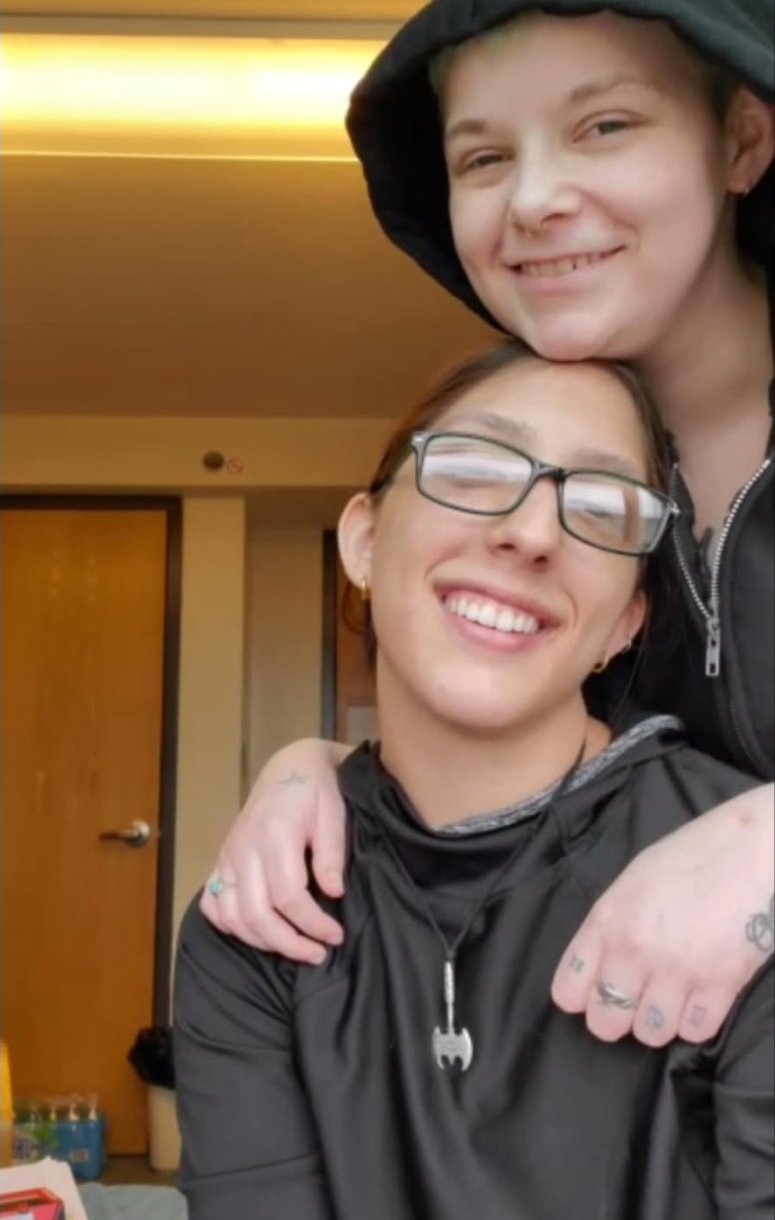
She eventually could not withstand her father's mistreatment again and moved in with friends in a small village in Ohio. I visited her from time to time in Ohio and she came to visit me when I stayed in Bloomington, Indiana.
I intentionally never learned to braid my hair after my mother passed and Sami would braid my hair for me, something culturally significant that my mother used to do for me as a child. Sometimes, Sami would place a flower in my hair, reminding me of the Jasmine flowers that Indian mothers in Bangalore often placed in their daughters' hair while I was growing up.
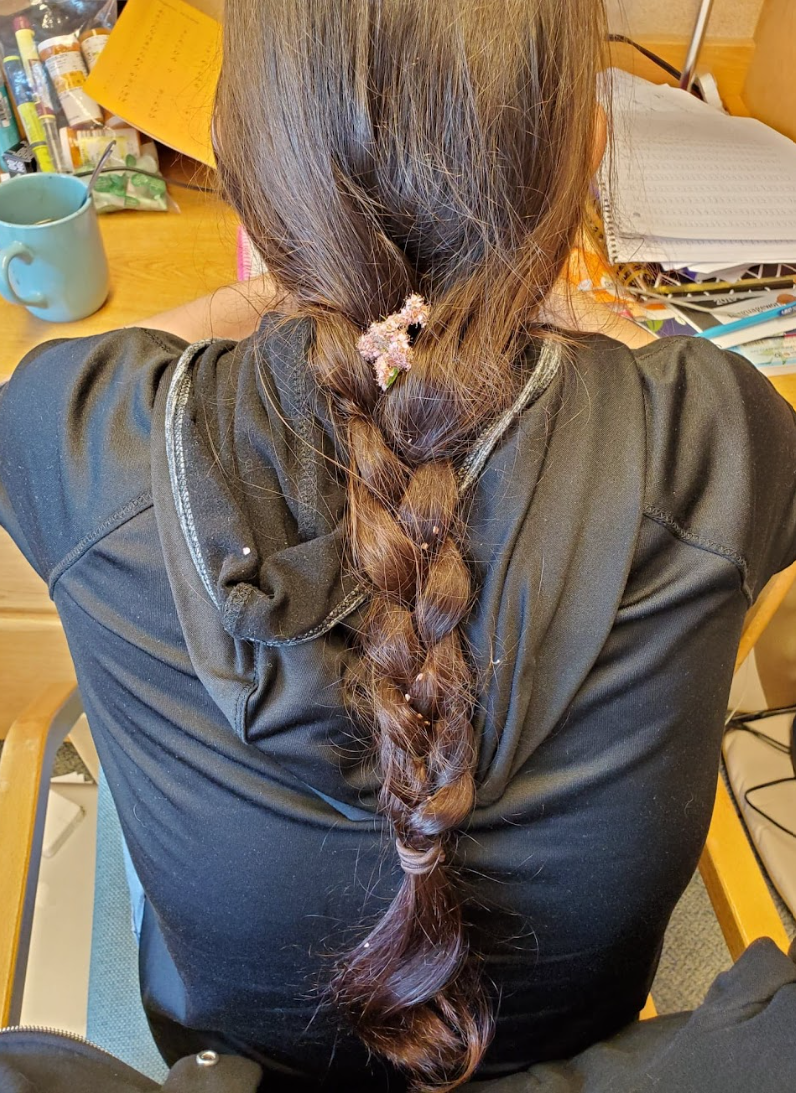
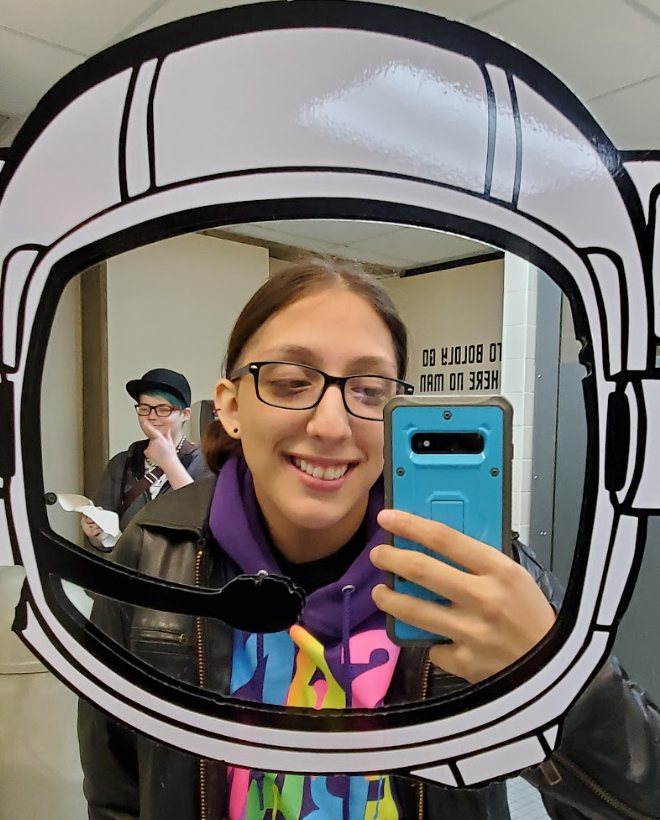
During one visit to Ohio, I was partially blind from a migraine and got in the ambulance with Sami, sitting in the front. The EMT in the back was yelling at Sami telling her she needed to sit down, but the pain she was in caused her to attempt to stand and stretch for relief. After a few seconds, I turned and lit into him, and we went at it for a moment until his partner yelled for both of us to calm down because he was trying to drive.
Sometimes my temper was the only thing that got her the care she needed and protected her from abuse, sometimes it did nothing at all. At other times, I had to hold my tongue even in the face of blatant medical negligence or risk providers taking out their anger towards me for daring to advocate, on Sami. An anger that ultimately seemed to come from having their authority and ego challenged.
It was during this same visit to Ohio that I almost got escorted out of the ER by security because I went in on a nurse for body-shaming Sami while she was vomiting blood, refusing to care for her because she had accidentally soiled herself in pain and was half-dressed. I cleaned Sami up myself and got her into a gown. I wish I could remember which ER this was, but all I remember was that Sami was in bad shape and ended up being admitted for several days to a city hospital some miles away.
I was only infuriated further when security stood menacing in the doorway of that ER. This caused Sami, in fear of being treated like trash by the nurse in charge of her care, to beg them not to take me between bouts of throwing up blood. I did my best over the years to teach her that she had rights as a patient, but often Sami couldn't articulate the care she needed if I wasn't there.
Once I had ensured that Sami was being properly cared for, I sat quietly out of the way on the floor. After some time, a nurse with the coolest tattoos I'd ever seen quietly moved me to a chair. She said:
"You did good mama, you want something to eat?"
In my exhaustion, I yapped at her that Sami was the nicest person you could know when she wasn't sick. She handed me a cheese stick and a cup of water and told me that she understood and that she was familiar with what chronic pain looked like. All of a sudden, I was starving.
I was 23, it was 3AM, and I felt adrenaline pumping through me to keep me awake. Even though I was hungry, I couldn't take my mind off of Sami. I forced myself to eat that cheese stick so I could have more energy to care for her in case she needed me again.
Sami's friends in Ohio also had children. This meant limited resources and means to care for her themselves. What aid Sami received went to them and they tried their best to help but ultimately the stress of caregiving caused tension and fighting. If Sami needed to smoke for pain management, she was out in the garage in the dead of winter and slept on a couch she described as being infested with bed bugs at times. While she was visiting me in Bloomington, Okami died of old age. After one last argument, Sami felt she could not stay with her friends any longer.
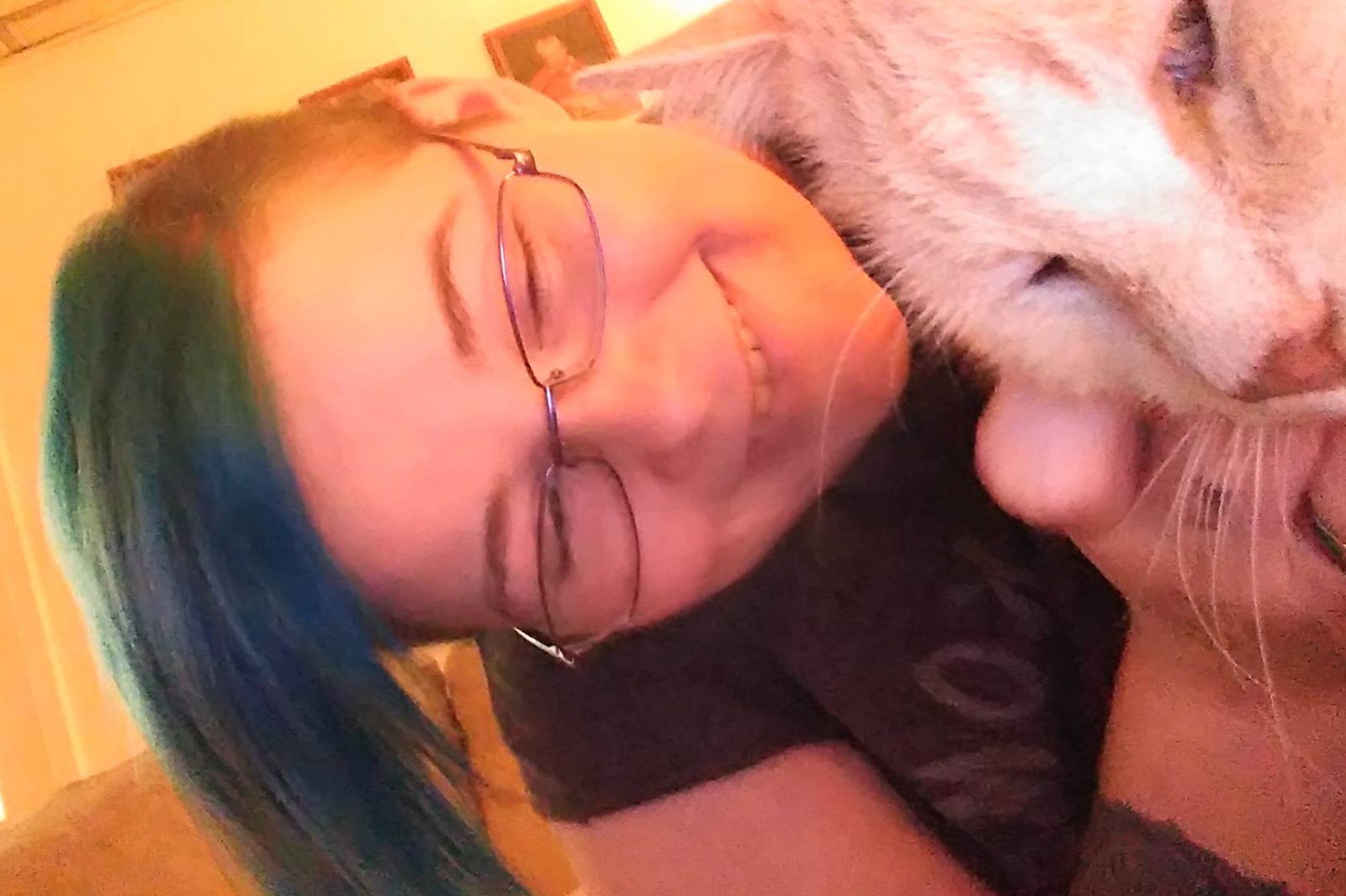
Rescuing Sami
At this point, Sami and I had broken up and broken off an engagement that would have led to our relationship being officially recognized after almost 4 years of being together. Her mental health had deteriorated, and she lashed out at me. I knew her condition would cause her to not be herself at times, but though I had forgiven her, our romantic relationship was past the point of mending.
It was rough for both of us, we had been calling each other wife for some time, and I knew that in my heart I would always love Sami. Time passed, and after a series of unsatisfying temporary connections, I met my current wife and ended up moving in with her. This meant that I was finally solidly outside of my father's grasp. My wife chose to stand by me and supported me in my effort to care for Sami, who I had accepted at this time was dying.
After six years of constantly caring for and monitoring Sami and her condition the best I could while in Illinois, she finally came to stay with me. My wife helped secure us a new apartment so that Sami could have access to her own bathroom so she could take hot baths whenever she needed it to manage her pain.
We drove to bring Sami, her new cat Zune, and her things from Ohio. My wife was in graduate school at the time, and had to wait at a mall taking an online class she was enrolled in. Without having my license yet, I drove to get Sami, and we brought her safely back with us to Bloomington, Illinois.
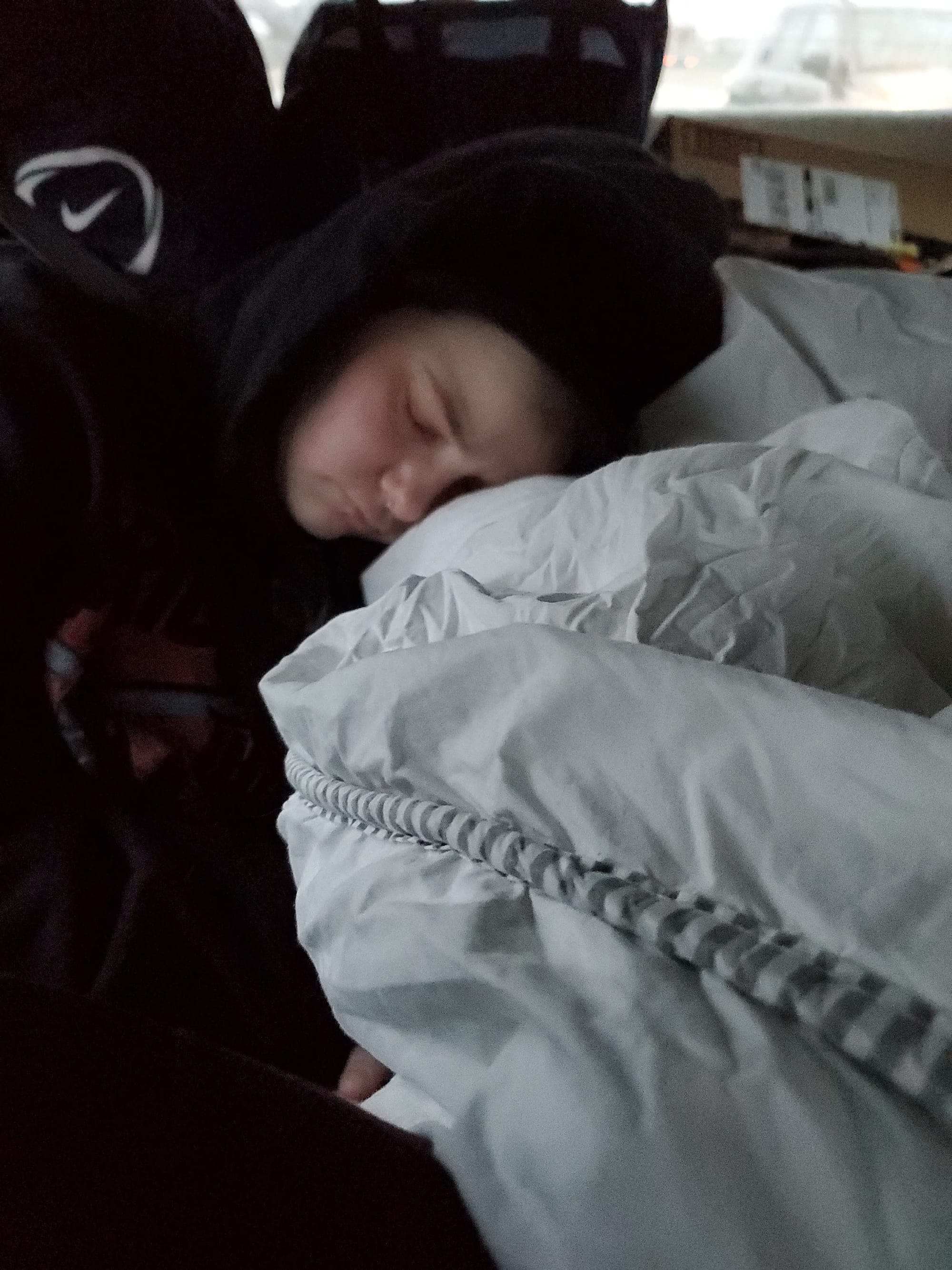
I hadn't planned to work full-time until after I finished my program and had only taken on part time work while I focused on my education. With my wife's help, I was able to finally obtain my license, and I managed to land a job as a medical laboratory scientist while still enrolled in my clinical program.
My brother had been kind enough to buy me my first car. My dad, a man who hadn't held a job since a brief stint as a Census worker the year after my mom died, promptly took that car for a late-night drive, fell asleep at the wheel, and totaled it before I could ever sit in the driver's seat. So, my brother got me another car. An older model, but I adored it. I thanked him, grateful for his support, knowing how big of a help it would be in caring for Sami.
The three of us lived in rough conditions at the new apartment, with a white neighbor who would, whenever Sami got sick, bang at our door in nothing but a wife-beater and boxers and armed at the hip no matter how quiet she tried to be. We had limited hot water, which would go to Sami's baths, and I put most of my effort and money into making sure Sami had what she needed. Our lease was only for six months, so most things for my wife and I stayed in boxes throughout the apartment.
The last day of us moving out, I was cleaning the apartment alone when there was a shooting in the parking lot. I got on the floor and waited until the gunshots stopped, then returned to cleaning. I ignored the knock at my door I knew to be the cops going door-to-door and then booked it before I could finish.
Before Sami's benefits transferred over to Illinois, my wife and I would drive to Ohio and I would pay out of pocket to pick up her insulin and supplies for her insulin pump, which the pharmacy there refused to sell to me until I lied that I was family. Her care was expensive and we didn't have community support or ability to ask for mutual aid.
The only person that volunteered to help at this time was my hacker mentor and stand-in father figure who resided in Colorado. He helped cover rent in the beginning when we needed the extra help so that we could bring Sami from Ohio sooner.
At 25, I worked three twelve-hour "graveyard" shifts a week to earn as much as I could and took out loans for whatever care and necessities my pay couldn't afford. The first day we brought Sami home, we hadn't a bed in the apartment yet, so we all slept beside each other on the carpeted floor of Sami's new room.
I furnished her room in the apartment nicer than any of the others, she had a soft bed and galaxy-themed blankets and curtains since she loved space. She loved foxes, so she had many plush foxes that sat on her bed waiting for her to return from the hospital. My wife gave her a couch she used to use, and I set up a TV for her because she had nightmares that stemmed from the abuse she endured at the hands of her ex and as a result could not sleep in silence in the dark. Her bathroom was space-themed, with Pokémon stickers stuck to her mirror and she had a neon-green pet fish named Limeade for some extra company.
I kept Sami's safe foods on hand and the minifridge I gave her from my time spent in a dorm stocked with juice for her low sugars. At first, I'd make the trips to buy her weed myself, though I didn't smoke yet at the time and knew nothing about the different strains. Sami patiently educated me on what works best for her pain while making her the least head high.
I made sure her kitty Zune had food. I cleaned her room for her whenever she was too sick to clean. She was night-blind and scared of complete darkness so I stuck glow-in-the-dark stars on her ceiling and gave her a moon light she could carry with her. She told me that she'd "never had a fancy room with a fan on the ceiling" and that she'd never had a room this nice before. She was happy to finally sleep in a bed again. To me, it was worth every penny.
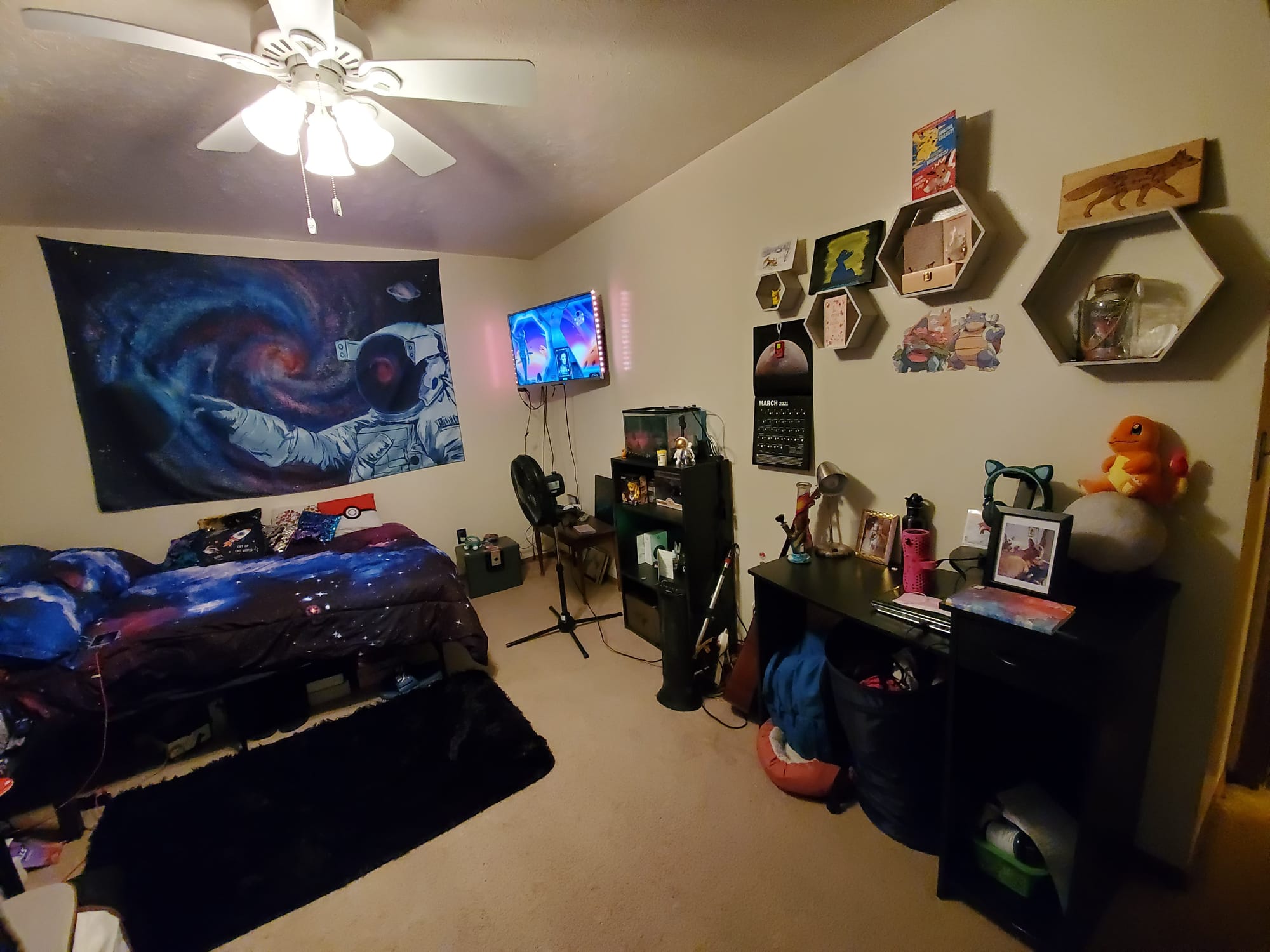
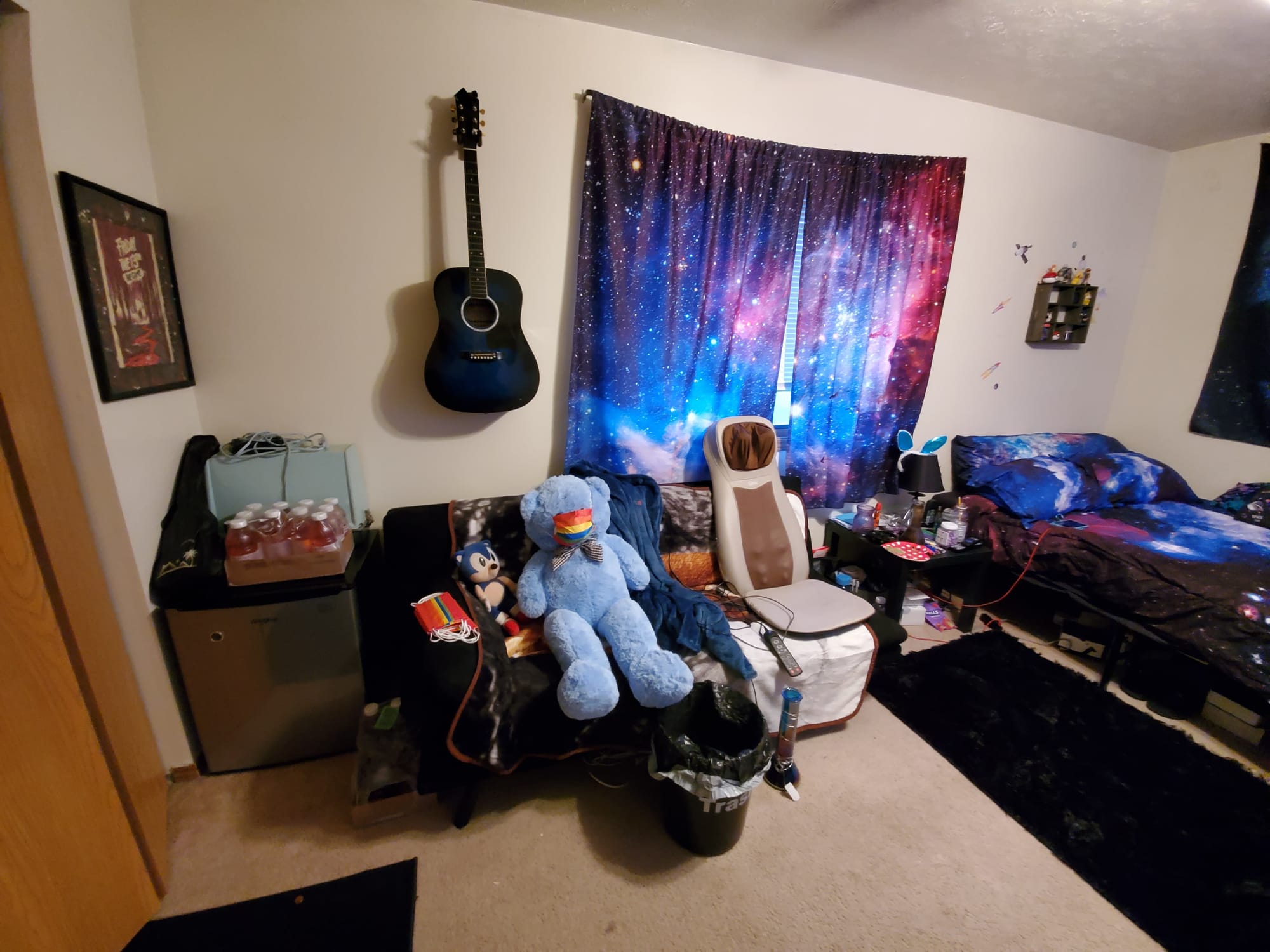
She was finally home.
Sami lived with me for a year and a half, and my friend at the time was able to help us out here and there when we moved to Champaign. She helped Sami pick up her meds, spent time with her when my wife and I were working full time, or took her to the dispensary where she could at last have legal access to medical marijuana. In Bloomington, other friends picked Sami up from the ER on one occasion when I could not. This help was beneficial but very limited.
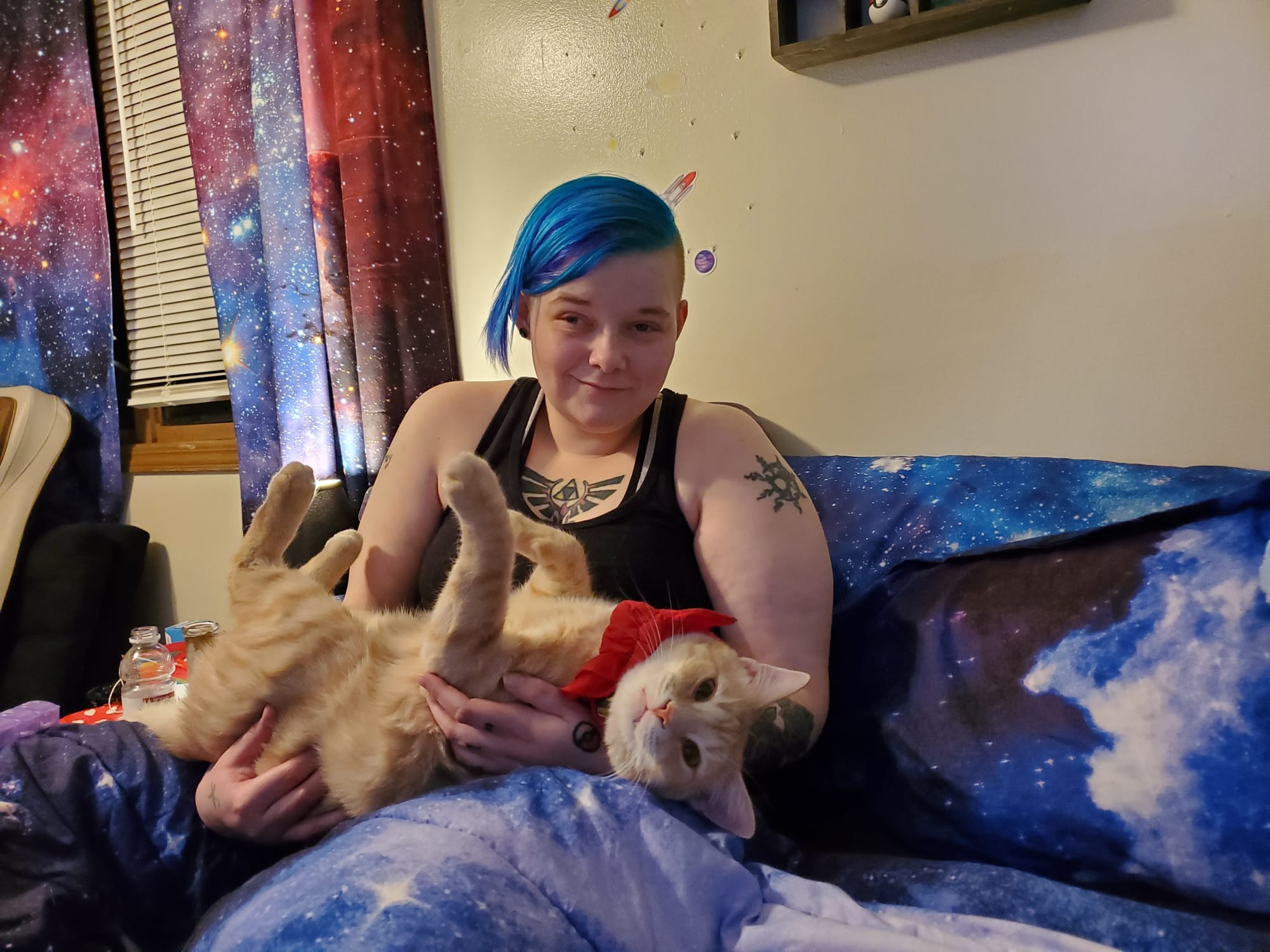
I got a job at the hospital I knew she would be admitted at in Bloomington so that I could be more involved in her care. I got to work on her samples as they came into the lab when she was admitted or could ask other laboratory scientists. This allowed me to keep track of her health more accurately and be sure of her test results and kept me in the know if she was admitted while I was working.
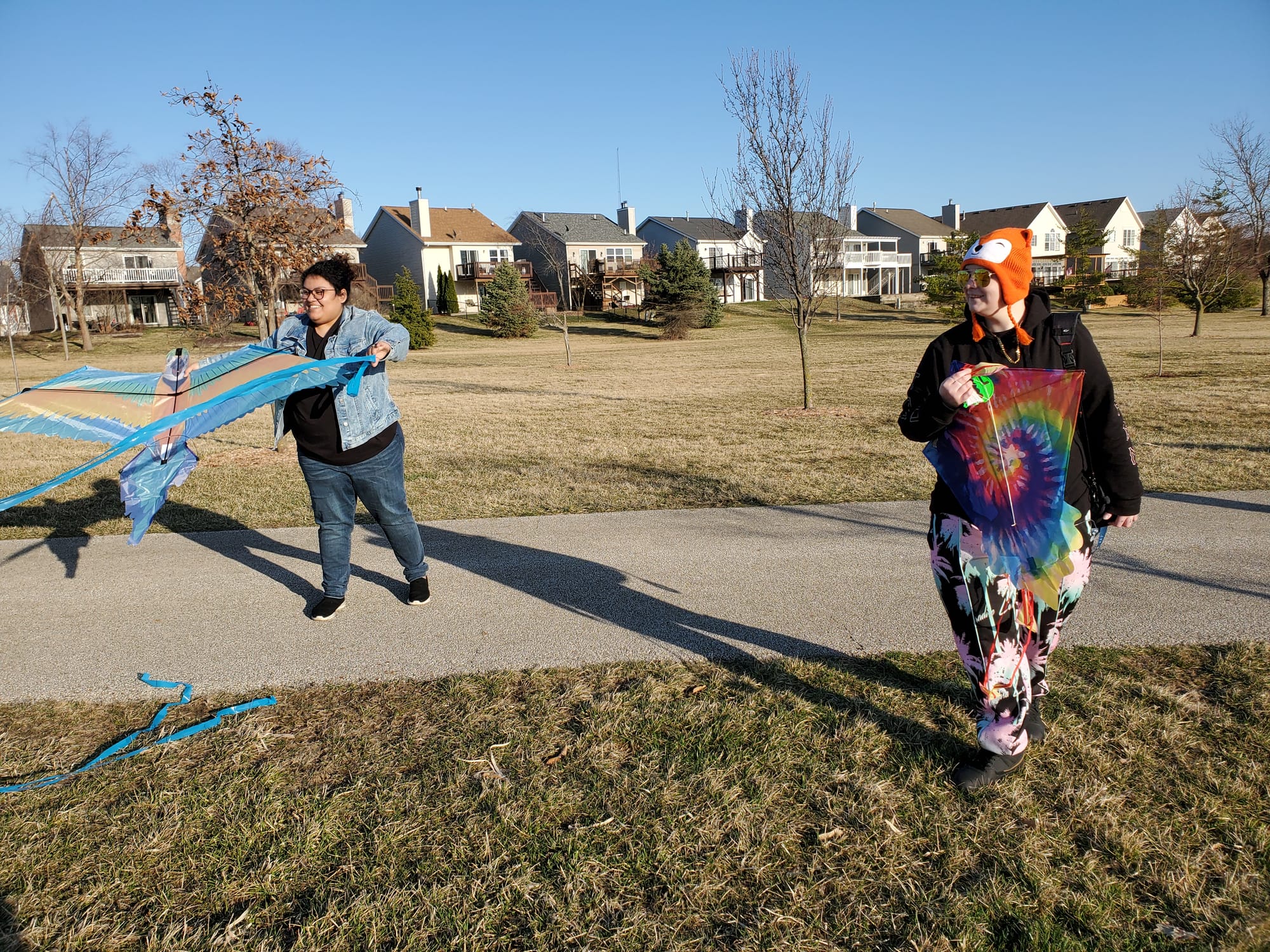
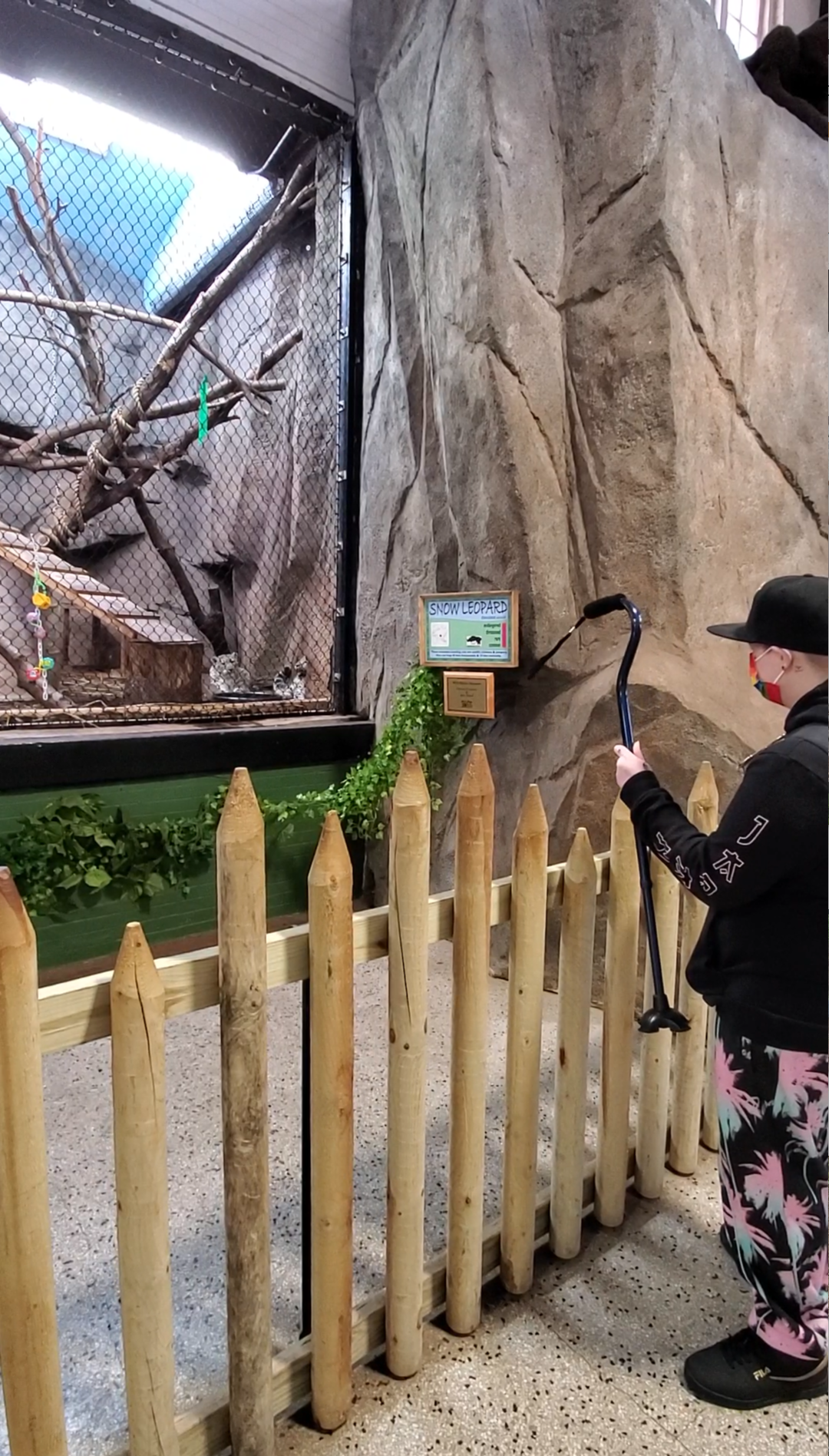
I tried to plan fun things for the three of us to do together, knowing Sami didn't have many opportunities to leave the house. My wife loved flying kites, so we all went to a park for some fun at one point. Sami also enjoyed visiting the baby Snow Leopards at the zoo in town to dangle the tassel from her cane in front of the glass and watch them dart back and forth playfully like giant kittens.
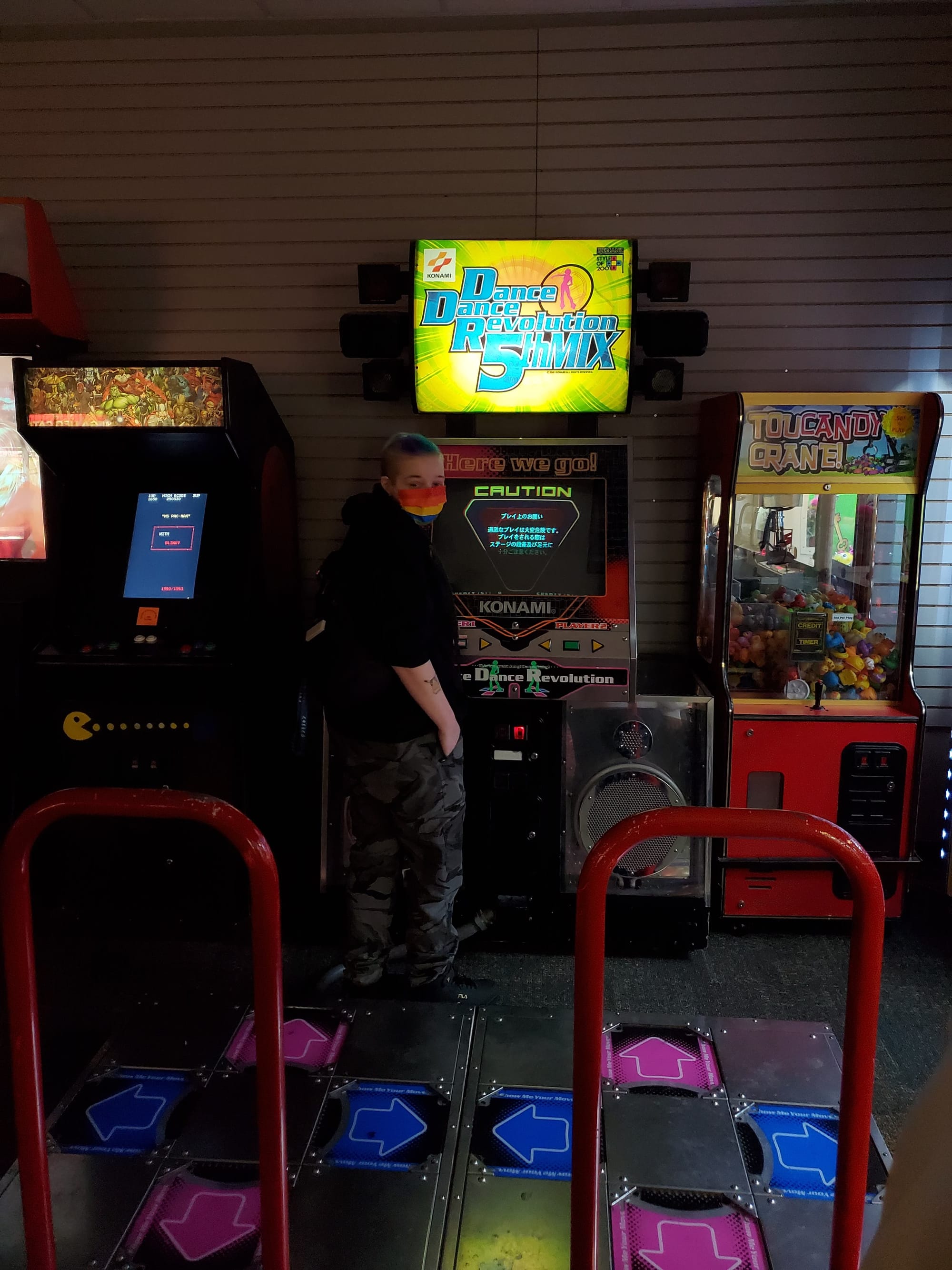
Sami absolutely loved DDR and I found a place at the mall nearby where she could play it. We only managed to go once, but she had a lot of fun.
I was eventually able to save up enough to rent us a house in a quiet neighborhood in Champaign and I commuted from Bloomington to Champaign after my over-night shifts. Exhausted and drained but still caring for Sami. At this point, her samples would not go to the lab I was at. We moved Sami into the house first before our lease in Bloomington ended.
Our neighbors in Champaign were elderly and white and did not seem to like the new brown gays who had moved in across the street or their alternative friend whose care required an ambulance at least once a month. We received passive-aggressive notes at times, or a notice from the county on the state of our backyard, because God forbid with everything else going on we forget to mow the fenced-in backyard and someone called the county to complain about it.
I ended up hiring someone to take care of the lawn and he graciously took care of all of it without stripping our pockets even more than they already were. Our saving grace was an elderly lesbian couple, who lived beside us and who would at times tell us if we forgot something or fill us in if we didn't know something.
Caring for Sami
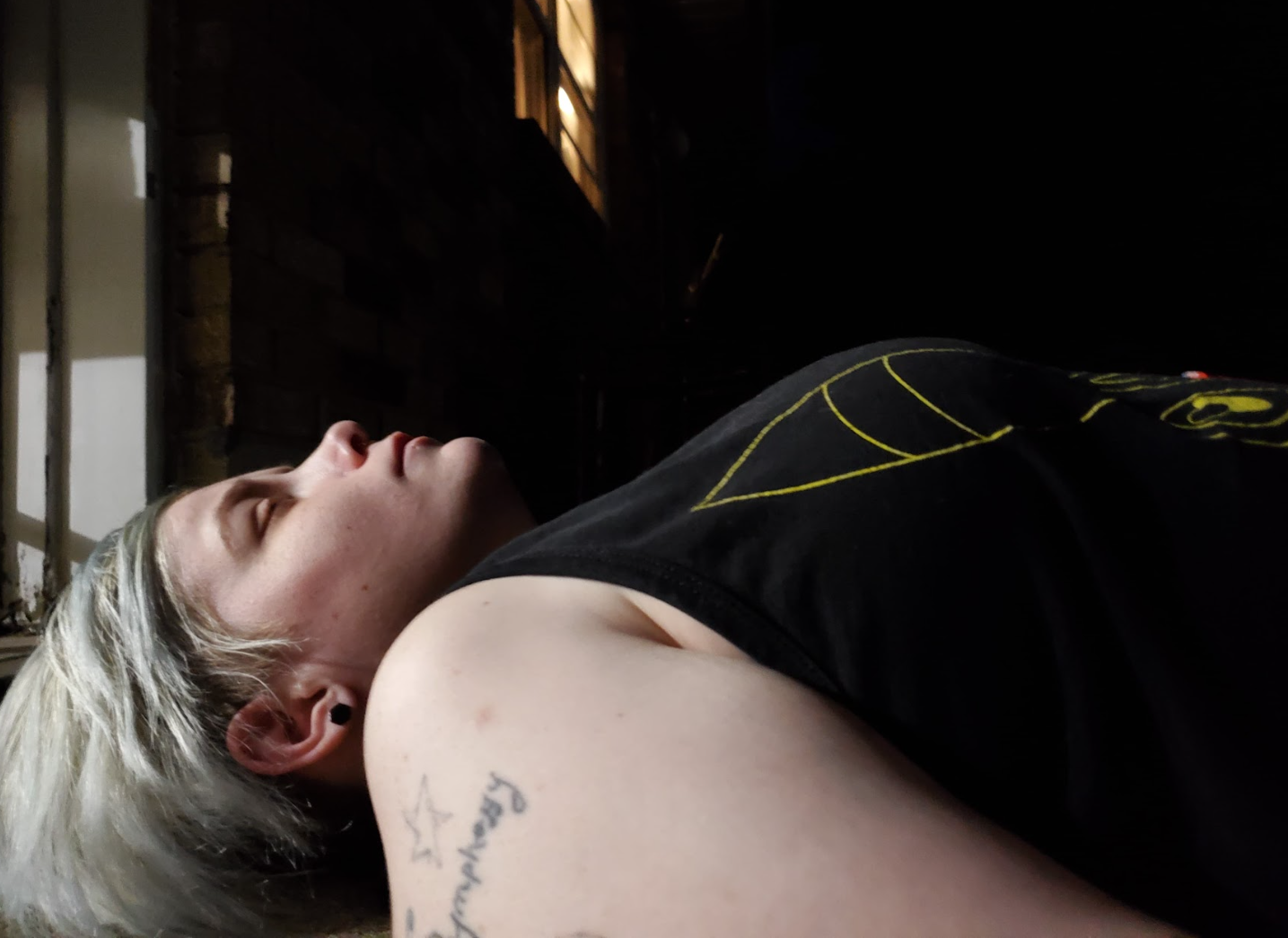
I did my best to care for Sami, getting up at 3AM if I heard the bath running, and getting a bag ready for her if she needed to go to the hospital before sitting near the tub. Comforting her and telling her that she was loved and nobody was mad at her. She would sometimes ask me to sing to her, much like a sick child would, or ask me to read to her. Her favorite book that I read to her until the cover fell off, was The 13 and 1/2 Lives of Captain Bluebear. She'd laugh during times of calm, as she sat in the bath, listening to me voice the characters.
She'd ask me to play music, her favorite song to request was Michael Jackson's Stranger in Moscow, though sometimes she'd ask for Billy Joel's And So it Goes. She loved music, had a small collection of guitars she used to play, and would tell me about the times she got to play the keyboard while living with a friend. She would share her gaming knowledge with me, teaching me all the cheat codes:
"Up, Up, Down, Down, Left, Right, Left, Right, B, A, Start."
I often complimented her impressive knowledge of video games and their history, and she would say she didn't really see any worth in it. I wish she could have, I bet she would have made a great game developer.
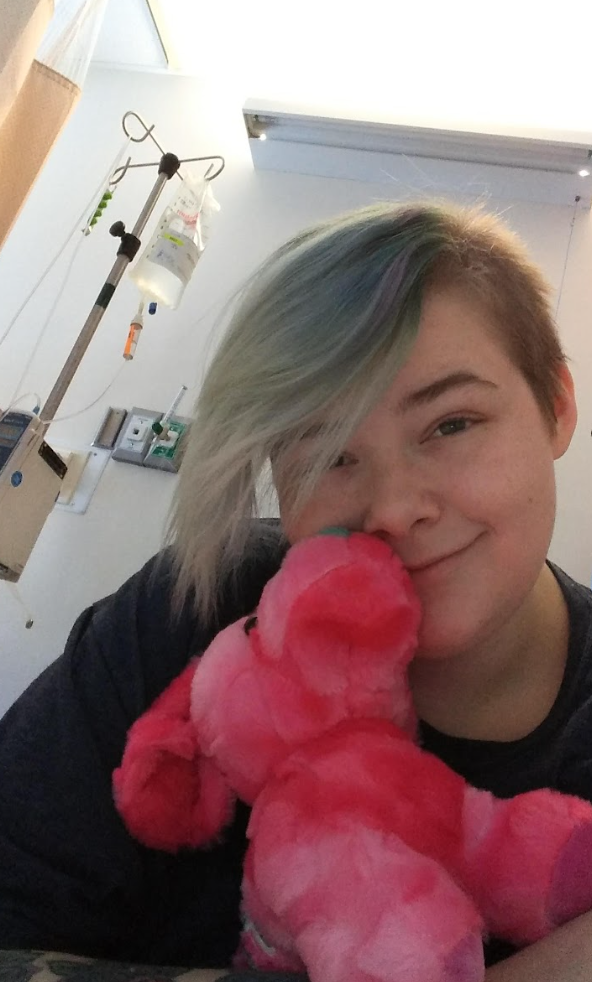
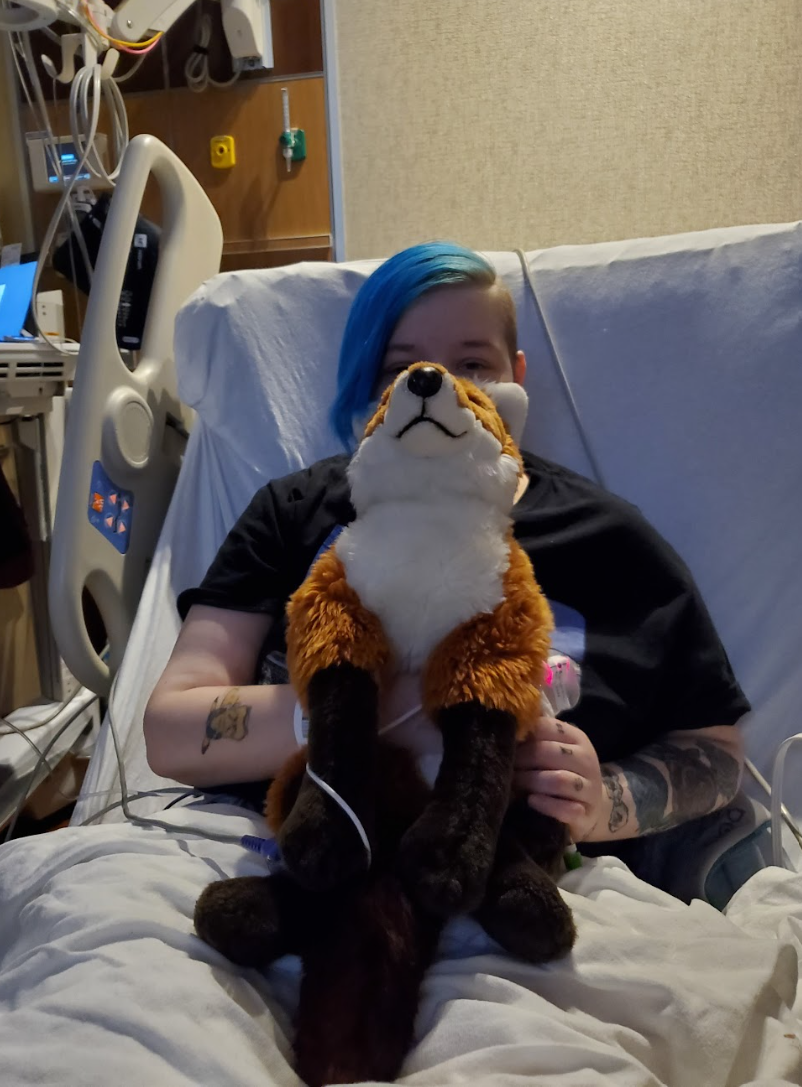
Left: Sami holding "stuffeddog" a plush I got for her during one of my many visits to the hospital.
When I could, I'd spend time with Sami, watching Steven Universe or gaming beside each other. For my 26th birthday, when I was too tired from work and my wife too burnt out herself from her social work practicum to do much, Sami made me a gluten-free cake with the help of a friend. It was a simple sheet cake, but to this day it was the best birthday cake I've ever tasted.
I'd visit Sami often when she was admitted to the hospital, bringing her anything she needed. I'd pick up and keep track of her medicines, empty and clean out buckets of vomit when she was sick, and massage her back until my hands were cramped and burning - anything to help with her pain.
I landed a job in Laboratory Information Systems at a local hospital so that Sami would again get admitted where I worked. I had a desk job at this point and wasn't down in the lab to run her samples anymore.
If Sami was asleep when I got off the clock and could visit her, I'd leave a note letting her know I was there. If I really couldn't visit, I'd video call her when she woke up. At work, I told people she was my half-sister. It was too exhausting to explain the entire situation.
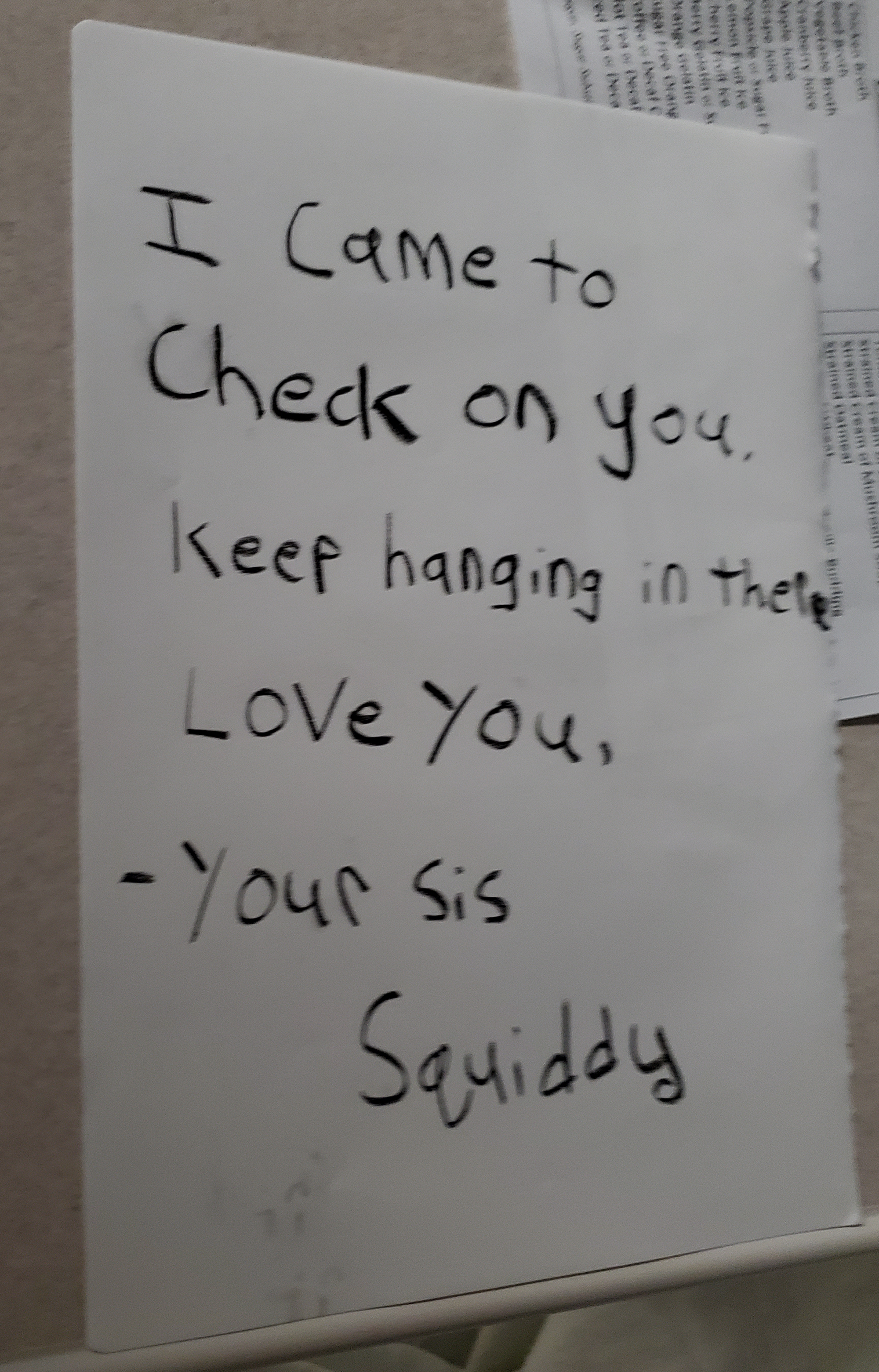
I was as close to her at this point as a sister would be anyways, and we hadn't been together for several years at the time. She still affectionally called me jayvorite, her favorite Jay, since she knew two.
My wife and I both being immunocompromised, we had somehow managed to avoid contracting Covid thus far, but that changed when Sami paid a visit to her dad and brought it home. I refused to let her isolate anywhere else but with us, setting food and medicine outside of her room while she did her best to keep her distance. We both ended up getting badly sick, but Sami survived Covid.
Burning Out
I couldn't maintain working third shift three times a week an hour away and grad school on top of being a full-time live-in caregiver. I searched for a job in town and landed my first corporate position for a team who assured me "we're all like family here" - my first warning sign. Within two years of taking that job, I burnt out fast and my own health deteriorated.
I had trained myself to be in tune with Sami's care to such an extent that the bathtub faucet turning on would wake me from my sleep. Whereas previously, the video calls shutting off would wake me up.
My thyroid was losing its fight against Hashimoto's and my weight skyrocketed. I gained a hundred pounds in a year, watched clumps of my hair fall out and my eyebrows vanish, and felt myself becoming increasingly irritable, forgetful, and fatigued.
My own chronic pain from years of physical abuse crept up on me. I had to pull myself out of bed by my hands due to damage to my lower back obtained during one of my father's fits of anger when, at 18, I "talked back" against him.
I did not want to accept my own chronic illness or that my immune system was fighting for its life under the stress of constant caregiving. I pushed through it until I was forced to accept that my health was struggling. I was in debt in terms of my own health and not just financially, but Sami was alive and cared for. It was all worth it to me.
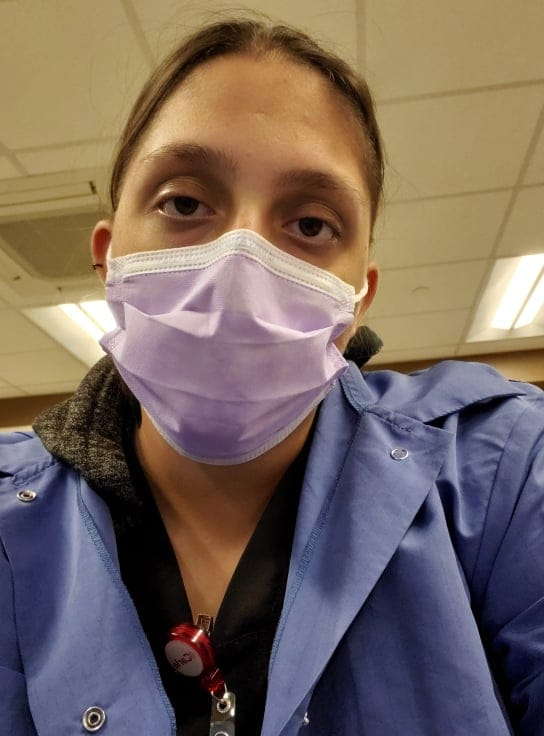
Working in corporate health care as a brown, autistic queer person experiencing burn out went exactly as one would expect and the job stress on top of caregiving placed me under extreme strain. My health fell to pieces and my relationship started to plummet.
I became angry and tired and avoided Sami frequently outside of caring for her. Sami noticed my health deteriorating much to my own shame. I wanted to be stronger to care for her, but my own health issues were steadily catching up with me no matter how fast I tried to outrun them.
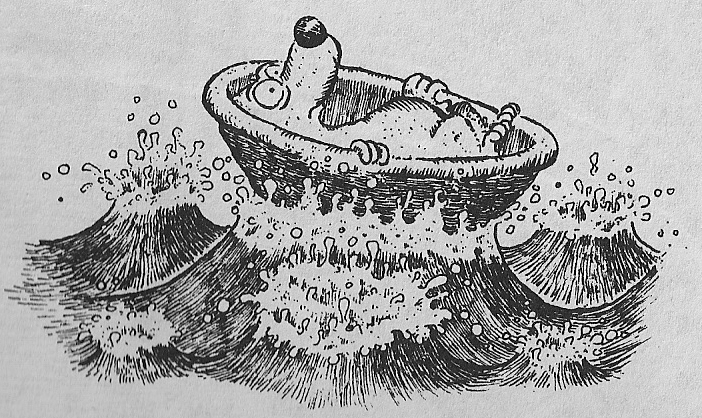
The more I had to mask, the more exhausted I became. I took to doodling the feelings I couldn't express. The lazy doodles took the shape of a goofy squid who could freely express the emotions I had to suppress.
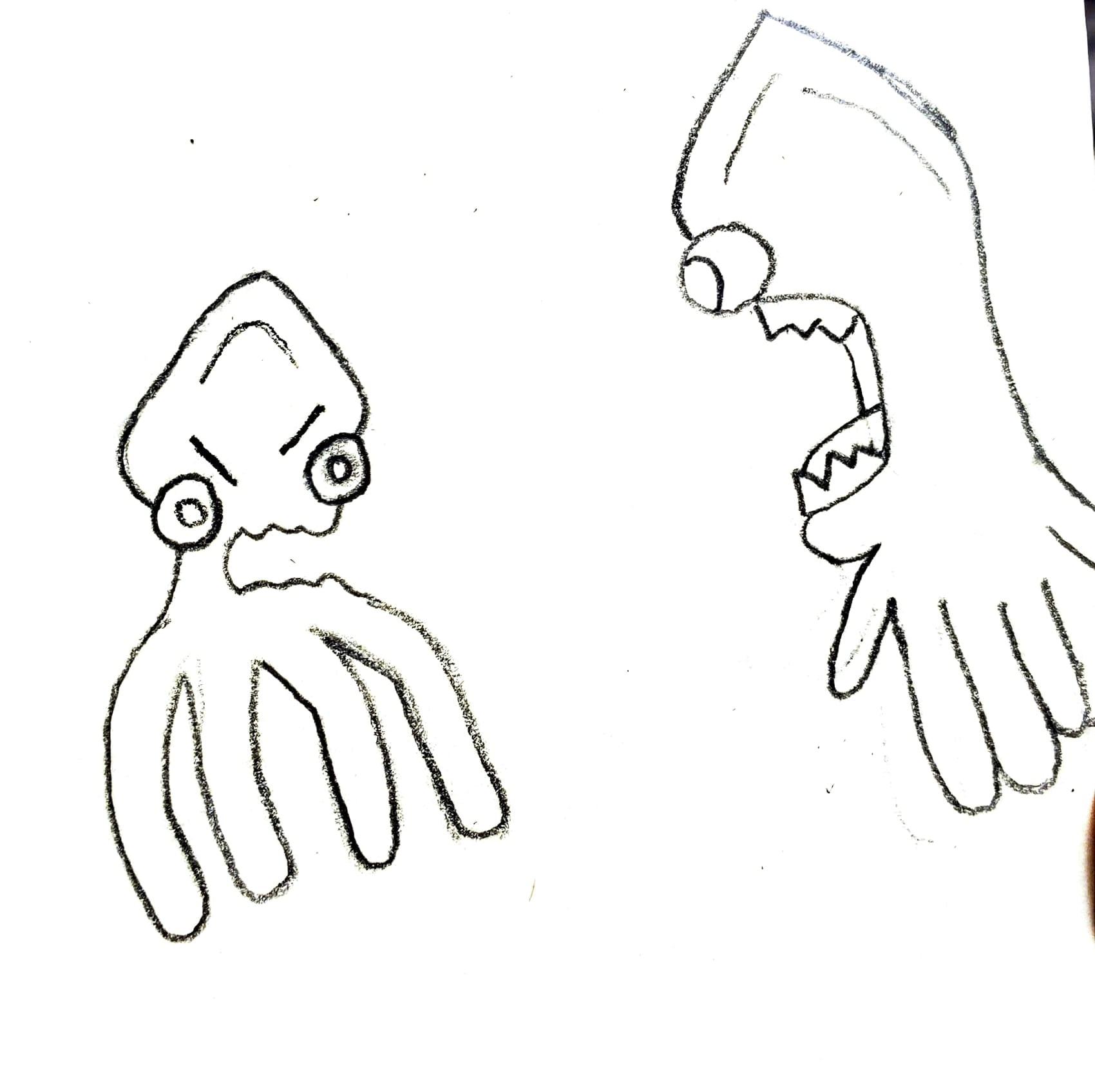
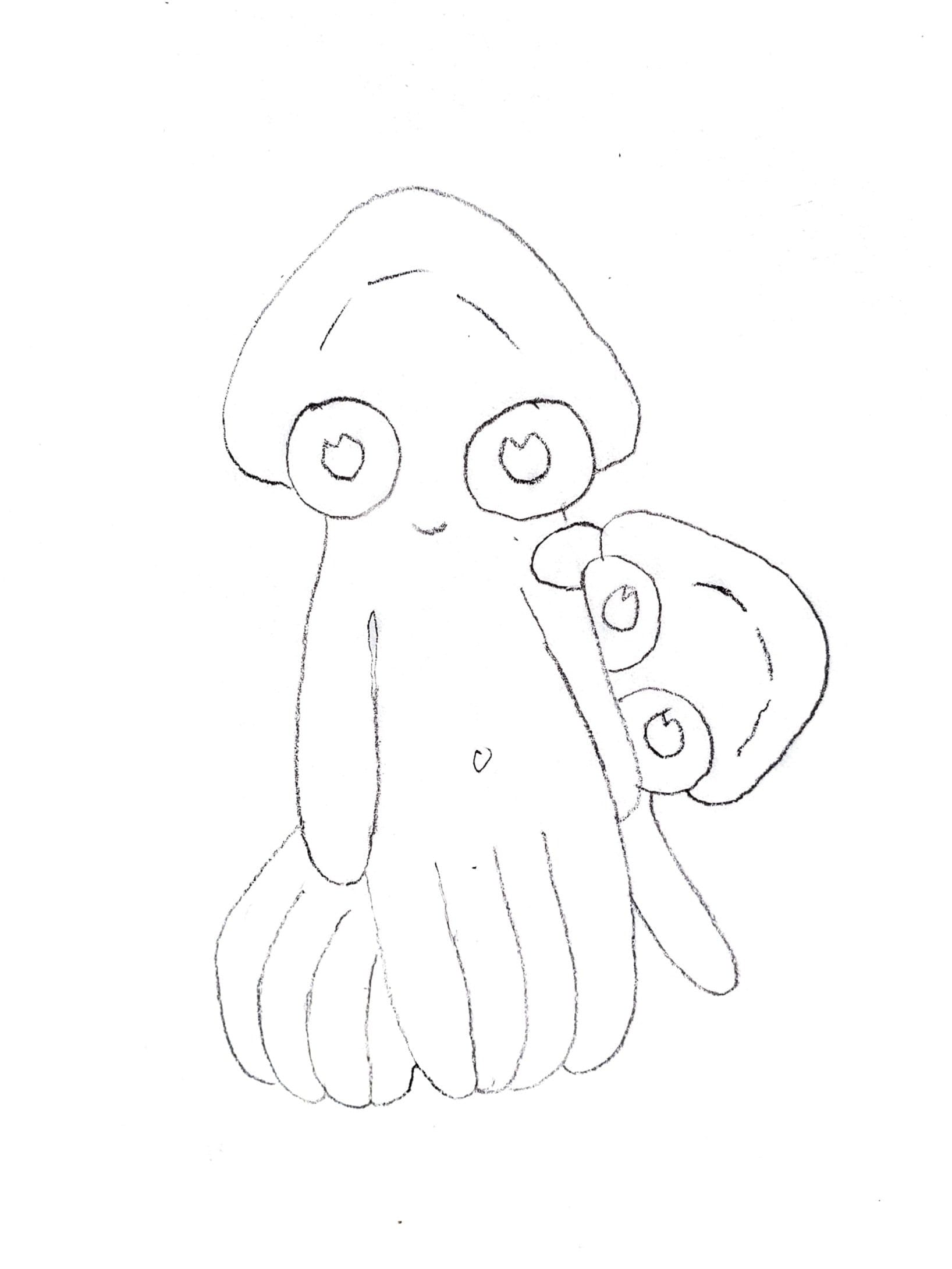
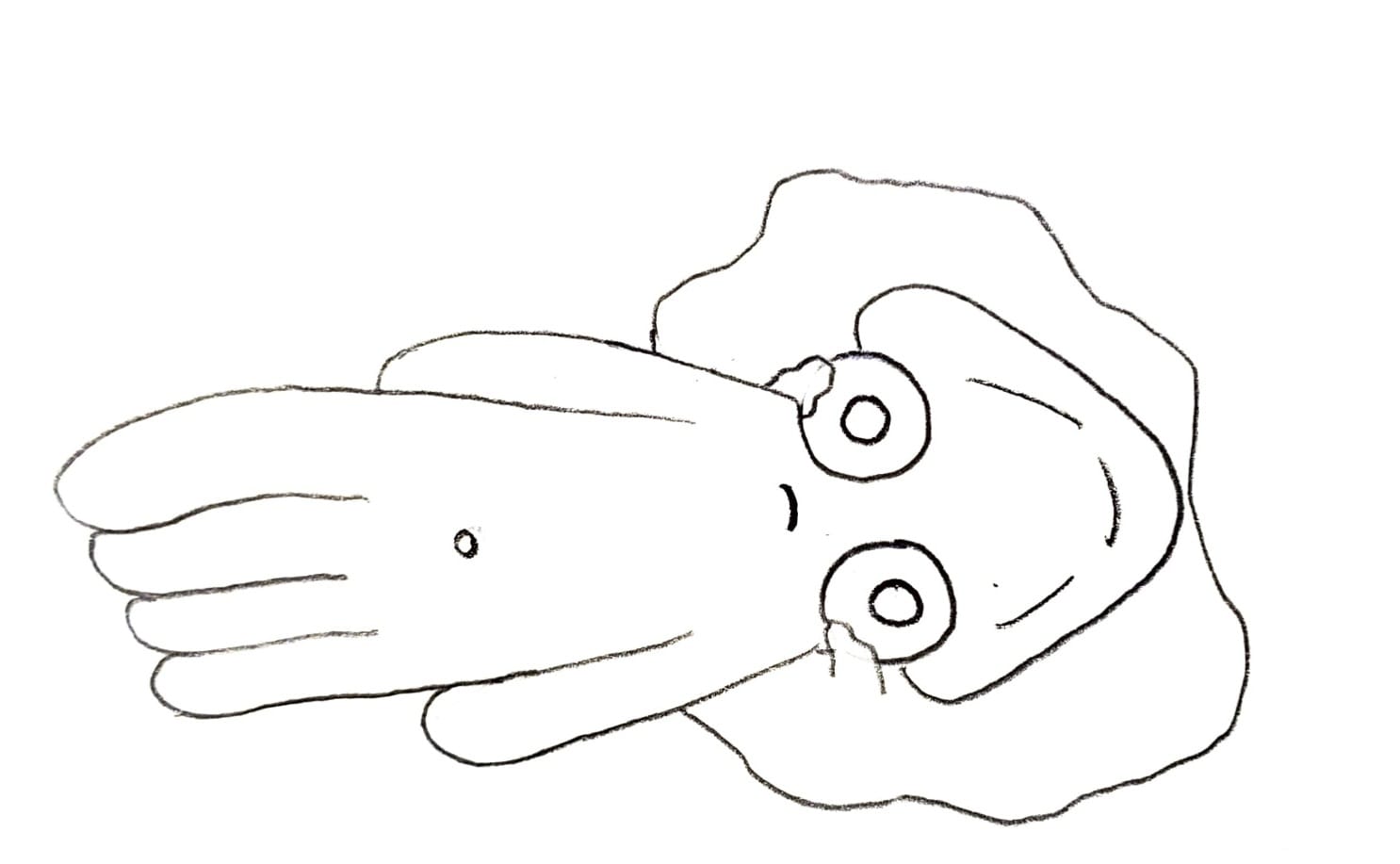
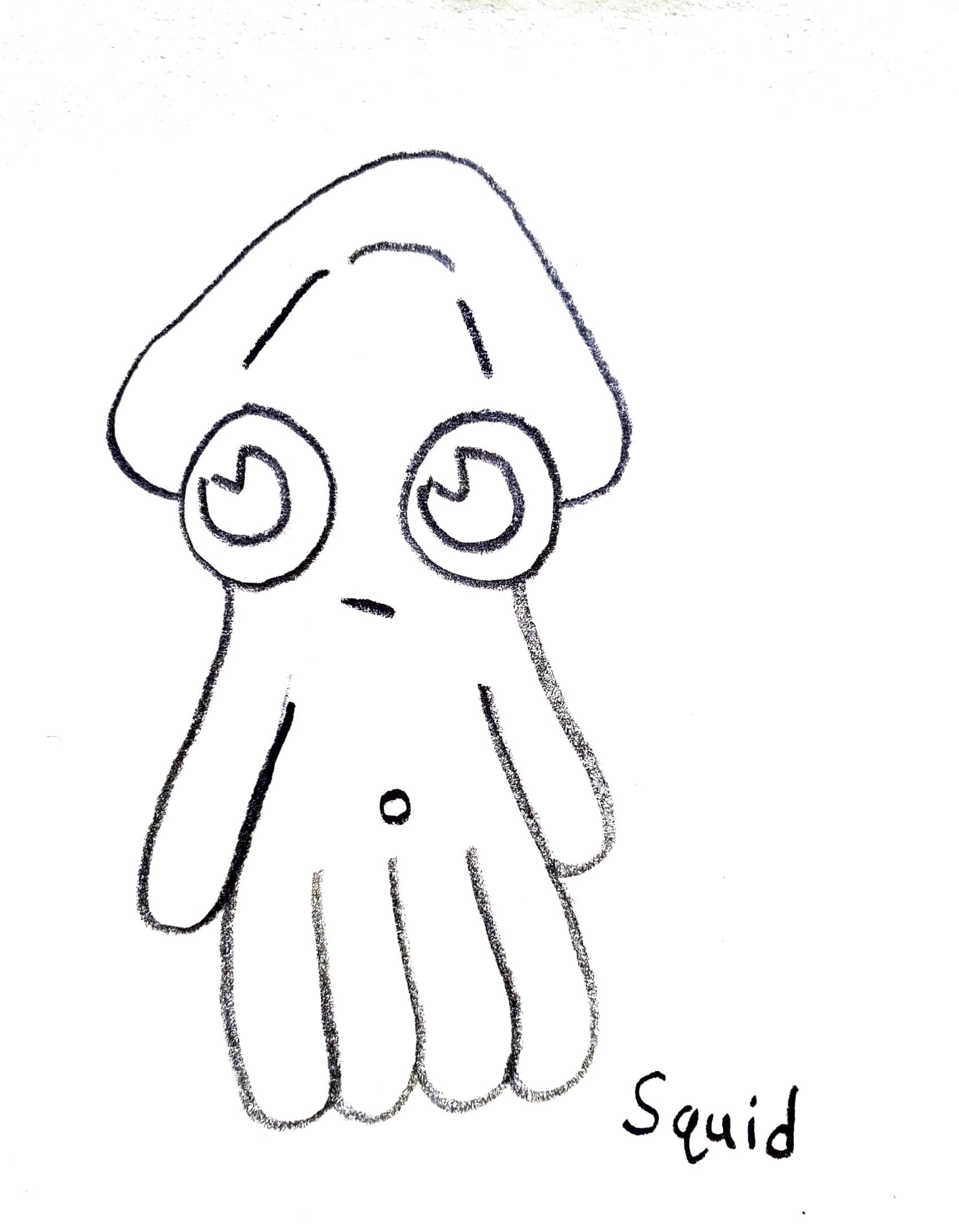
It didn't help that around this time I received a dual diagnosis of Autism and ADHD from my provider after going undiagnosed for 26 years. Growing up as a young brown girl, I had simply been labeled as oppositional defiant and potentially Bipolar. Autism was considered a white boy's condition.
Older white adults in my life had jeeringly referred to my strong sense of justice as a symptom of being a "Cluster B" and openly debated if the CTPSD I lived with from going undiagnosed for so long was actually BPD. It was these older adults who labeled other tendencies of mine, such as penguin-pebbling to appreciate a connection, as love-bombing.
Any meltdowns were not granted the grace that straight or white neurodivergents might receive but instead used as proof that I was an aggressive, brown lesbian.
As an adult in therapy, I started the active process of unpacking a lifetime of internalized ableism and learning how to unmask, leading me to experience skill regression that I still struggle with.
During this time, I had to navigate friendships as if I was unimpacted by everything and slowly begin to shut down and ghost friends. People, I learned, were more likely to tell me how overwhelmed and overloaded they were if I mentioned struggling through care with any level of detail.
I still had to finish graduate classes for my master's in health informatics. My weekends were spent studying whenever a break from providing care presented itself.
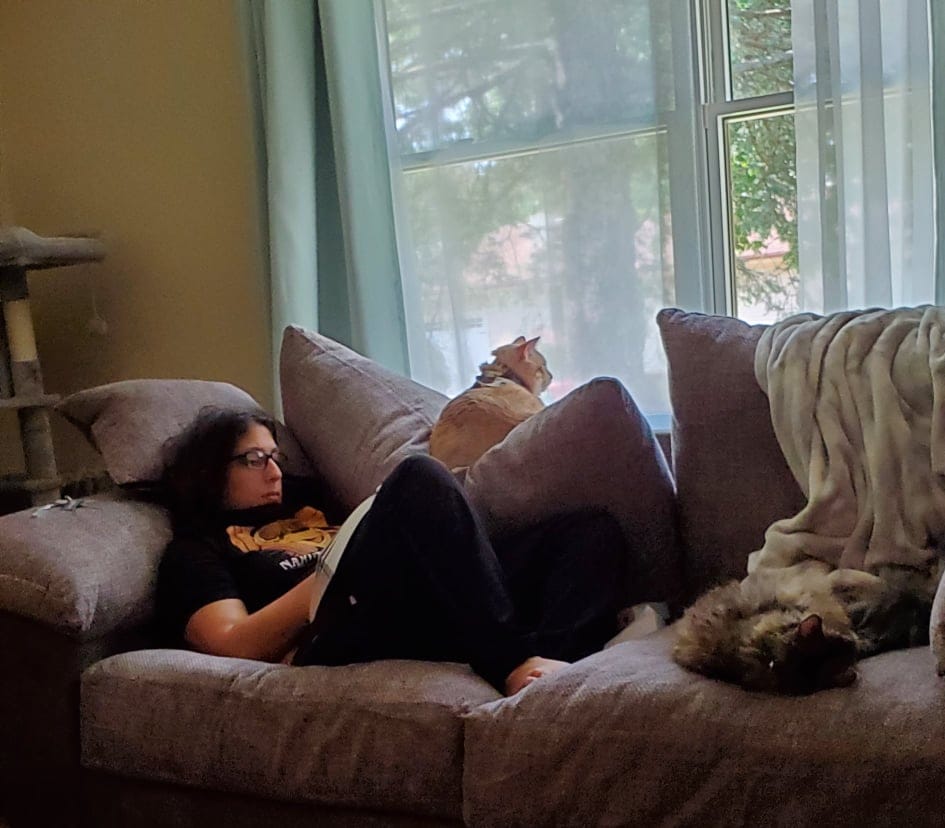
At one point, Sami got a new insulin pump and couldn't get in fast enough with her provider to help her set it up. She ended up accidentally setting the insulin bolus too high and one morning I woke up to strange, almost out-of-body screaming. Sami appeared to be asleep, but was yelling at the top of her lungs, as if she could not speak. She couldn't, and I did not know what was wrong. She turned and yelled at me, wordless, before faceplanting back into her pillow. While this image might be funny to readers, at the time it was terrifying.
I pulled her limp and moaning body to me, lifting her as best I could and looking in fear and desperation at my wife, who described my expression later as one she would never forget, similar to a deer caught in headlights. I tried to lift Sami and she seemed to wake. She stumbled into the hallway delirious and mumbling something about taking a bath. I got in her way and guided her to the couch, lifting her as she fell, stumbling, to get there.
I called an ambulance. The situation had jolted me out of my sleep, but I was still not sure what was wrong and did my best to describe her condition. I checked her sugar. It was 25. I tried to give her juice, but she choked and couldn't swallow and it ran down the sides of her mouth, trickling out. I switched to chocolate syrup, rubbing it on her gums but it wasn't working fast enough. In desperation, I remembered the glucagon kits Sami kept in the fridge for emergencies and ran to get one, my hands trembling as I remembered how to inject her.
The EMTs arrived and took over, trying and failing to check her sugar twice before administering a second kit. They transported her to the ER to get checked out and discovered that her pump was incorrectly set to deliver a higher dose of insulin. In the ER, she was given something to eat and released after her sugar was stable.
Sami had to wait to see her provider and set her pump before she could use it again. I continued to care for her, watching helplessly as her health dwindled despite exhausting every method of care in my arsenal and increasing the effort I put forth until I felt my own body giving out.
I leaned into the safety and warmth provided by my current partner, curling up in her arms when I was too weary to function. Being a full-time caregiver was slowly draining me until I couldn't recognize myself in the mirror. My wife felt helpless to protect me, and she was unsure of how she could alleviate the pain I felt. I was distraught knowing that if I relaxed for a second, Sami would surely die.
I reached my limit in the summer of 2022, a few months short of turning 27. My wife had recently gotten into a car accident after a woman ran a red light and hit her leaving her badly bruised, and leaving her car totaled and in a similar crumpled shape as my mother's when she passed away.
One evening, while tired and drained, I snapped at Sami. Though all I could get out was "you're 30!" I'm not sure what I was trying to say, but it wasn't kind in any case.
Her reply, which made me apologize then, eats at me now:
"Just because I'm 30 it doesn't mean that it doesn't hurt."
Even if my health was steadily fizzling out, she didn't deserve to be snapped at, and I was forced to admit that I needed to rest. So, when my wife asked me in a small voice "please choose me, we need a break" I said yes.
I went to Sami and I asked, as she was in the process of being waitlisted for housing, if she could stay elsewhere for just three months. If she hadn't been granted housing by then, I was prepared to buy her a trailer and pay for a healthcare worker to come care for her. At this point, she at least seemed able to care for herself to an extent or capable of asking for help when she needed it.
Sami agreed and went to stay with her father who she had maintained a strained relationship with, visiting him for the holidays. I worked on getting my health under control. I was able to sleep through the night peacefully for the first time in years, and asked for accommodations at work, which led to intense scrutiny but permitted me a bit of a break. We dropped Sami off at the end of March. At the start of June, just weeks short of bringing Sami home,
I received a message that changed the course of my life forever.
Goodbye, Sami Fox
It was a summer evening around 6PM, still bright out. I was sitting in the parking lot of Target with my wife after picking up a Bosu Ball to help manage my chronic lower back pain. I got a message from Sami's aunt asking me to call her. She was the one relative who seemed to love and care for Sami like a daughter, and who knew how much devotion I had put into caring for her. I called right away.
She told me that Sami had passed away that morning.
I heard what she said but it didn't seem real. A sound escaped me that I didn't know I could make, something between a sob and howl. Apparently, all I could do was repeat "no" until my wife took over and I calmed down enough to ask how it had happened. Her aunt told me that Sami's brother, who hadn't been home at the time, said she passed away quietly in her sleep from a low blood sugar.
Alarm bells went off in my head, my gut told me something was off. We were still in the parking lot, men passing by were staring at the tears streaming down my face while women politely averted their gaze.
Sami was my first life partner for years, but we hadn't married and so I had no legal rights over what happened in the event of her death. In the days that followed, her father burned her body without permitting me a goodbye, having her cremated as fast as possible. He made it known I was not welcome at her memorial.
I spoke to her aunt over the next week or so, and she told me that I should be involved in Sami's end of life ceremony. Sami's father was a man that Sami had described herself as a white supremacist with nazi symbols tattooed on his body. He had always been kind to my face and racist behind my back, threatening to kill me to Sami if I ever took her to visit India. Something I had contemplated doing only for access to affordable healthcare.
He refused to allow me to participate in Sami's memorial in any way. I quietly sent any pictures I had of Sami to her aunt, and they were included at her memorial anyways. Of the photos I sent, one of Sami and I together made its way into a photo collage that was set near the floor, alongside other photos of her with friends and family.
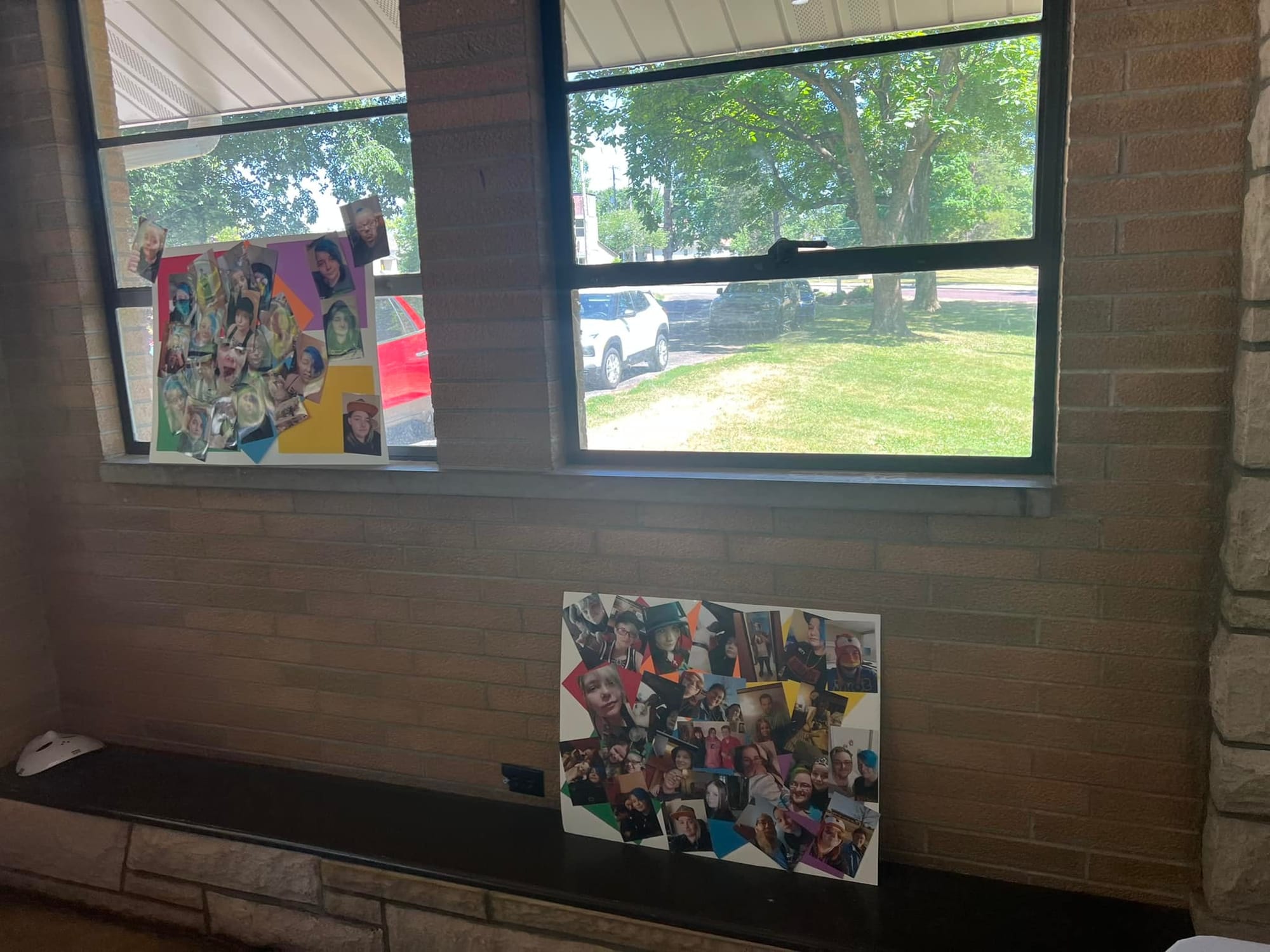
Though I was not permitted to be present, I sent funds for another close friend and former partner of Sami's to attend, even though I wasn't on speaking terms with this friend at the time. Friends of Sami sent me photos of her urn so that I may at least see what remained of my first love.
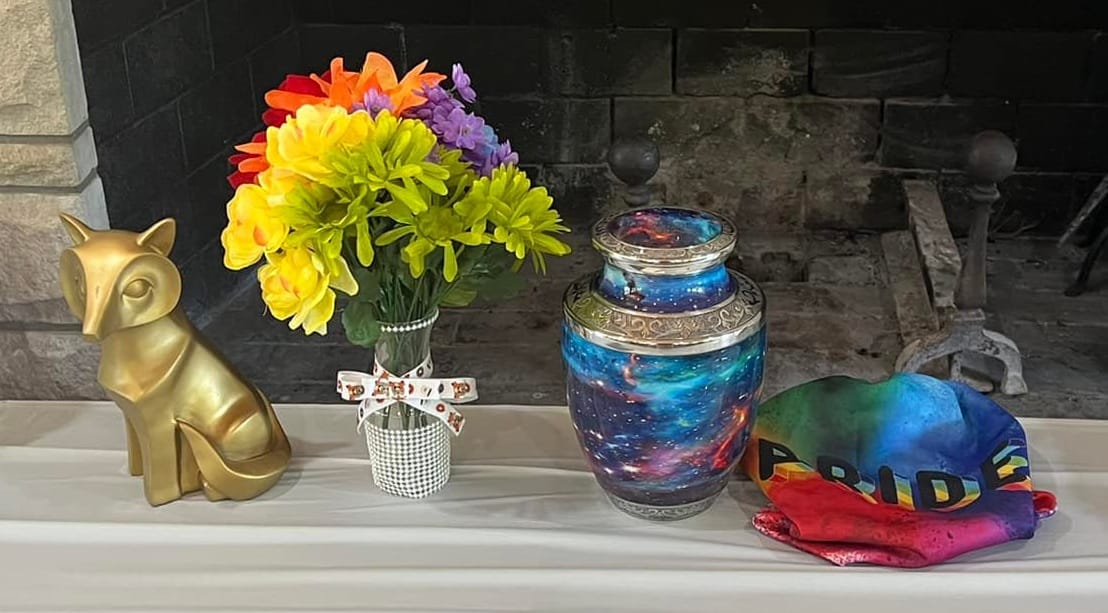
I found out through a friend Sami was close with that Sami had been in a flare up leading up to her death. Her flare ups are painful, she was always going between screaming in pain, asking for help, and not-so-quietly taking a hot bath. Someone almost always had to call her an ambulance as she was frequently unable to make the call herself.
These flares always caused her sugar level to skyrocket, often leading to ketoacidosis and even more intense pain. She suffered for days in extreme pain before dying alone. Her father was aware that she was suffering in pain and did nothing, leaving Sami to die horrifically.
I called the coroner to report a wrongful death. They called and interviewed the friend who had known she was ill at the time. But Sami was female, poor, gay, and her father was a veteran. It never went anywhere. I was also in dismay at hearing that her beloved cat, Zune, was given to her mother.
The only time Sami had talked to me about the possibility of her passing away, she strongly voiced that she did not want her things or her cat going to her mom or her dad. She was understandably too scared to write a will when I suggested it because it felt too final. Four years later, neither I nor any of the friends who love Sami have her ashes, as her father has kept them entirely for himself.
I was already in therapy, but I sought out additional counseling through the employee assistance program at my workplace, and an older, white coworker who I had shared an office with for two years said that if I needed anything I could ask her. I yapped to her about the death for a very short while until she asked me to stop because she "wouldn't be able to unhear it" and, as she was a type 1 diabetic herself, described the death as "triggering" for her.
The world went on uninterrupted around me, I still had to show up as if nothing had happened. That year, I helped my wife build an ofrenda for Día de los Muertos, obtaining the wood to build the altar, and retrieving marigolds from a kind stranger. We placed Sami on our altar, along with the friends and pets she had lost. When my brother heard of her passing he simply said "oh, Sami died? Sorry, Jay." That was the "support" from my own family.
After Sami's death, I looked through the recent medical notes she had left lying around - she was in stage 3b of chronic kidney disease (CKD) and headed towards renal failure. I hadn't seen anything in her record before indicating kidney disease. None of the doctors she had seen at Carle had put her on dialysis, and I couldn't believe I had missed something so crucial.
Her fear of death had recently led her to skip her appointments and indulge in whatever she wanted regardless of how sick it made her. At the time, I was frustrated with her, but now I understand that she likely knew her health was plummeting and hid it from me.
She had a tendency to hide things from me out of love and care and so that I would not worry more about her. If I had known just how close she was to her life potentially ending, I would have switched to end-of-life care, and she would have had anything she wanted.
It was my goal to at least help Sami make it to 35. Given the serious nature of her condition, turning 35 would have been a big achievement.
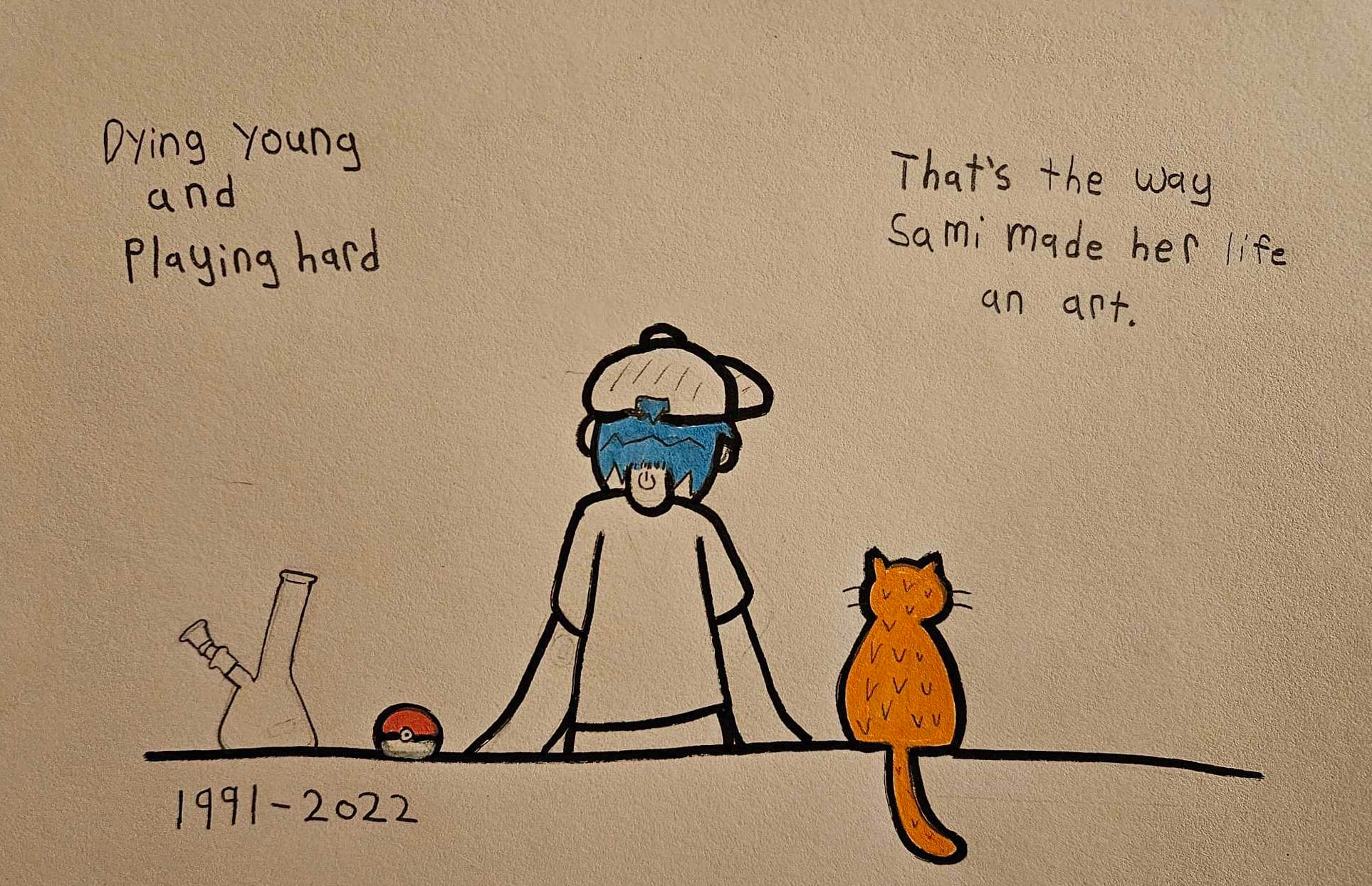
Her friend who was also diagnosed with gastroparesis told me that Sami understood why I had asked her for a break, that she was not mad at me, and that she looked forward to coming home. Sami had avoided calling me during her last flare up when she would call me every single time for years, no matter the time or day, because she wanted me to rest. If Sami had told me how sick she was, she knew that I would have driven to Kokomo myself.
Sami was going to ask her friend to live with her in her new home, and she had wanted to come home to me. I do not know if knowing this makes accepting her loss easier or harder. The Bosu Ball I bought the day she died, sits in a corner acting as a reminder of the day my life changed. I can't bring myself to use it nor to throw it away.
Sami was nothing like her parents. She was loving, kind to people and animals, hard-working, and intelligent. She put honest effort into becoming anti-racist. Educating herself if I mentioned something was hurtful despite limited spoons overall and calling out certain long-time friends for racist remarks, defending me.
Sami was talented and lots of fun, a great friend, and a creative who made wonderful art. She encouraged her friends to be their best selves and made us all feel like we could handle anything and become someone. She was the first to believe in many of her friends and teach us greater self-worth.
Sami had a dream of regaining control of her health and going back to school. She had hopes and aspirations for her future. She did not want to die and so she never made plans for her death. She was somebody's daughter, somebody's niece, and was herself a loving aunt.
Her life was meaningful and precious; she was deserving of proper health care and a chance to live out her dreams. She deserved to be respected and treated with the same kindness and dignity she awarded others. Yet her life ended before she ever got the chance to truly begin.
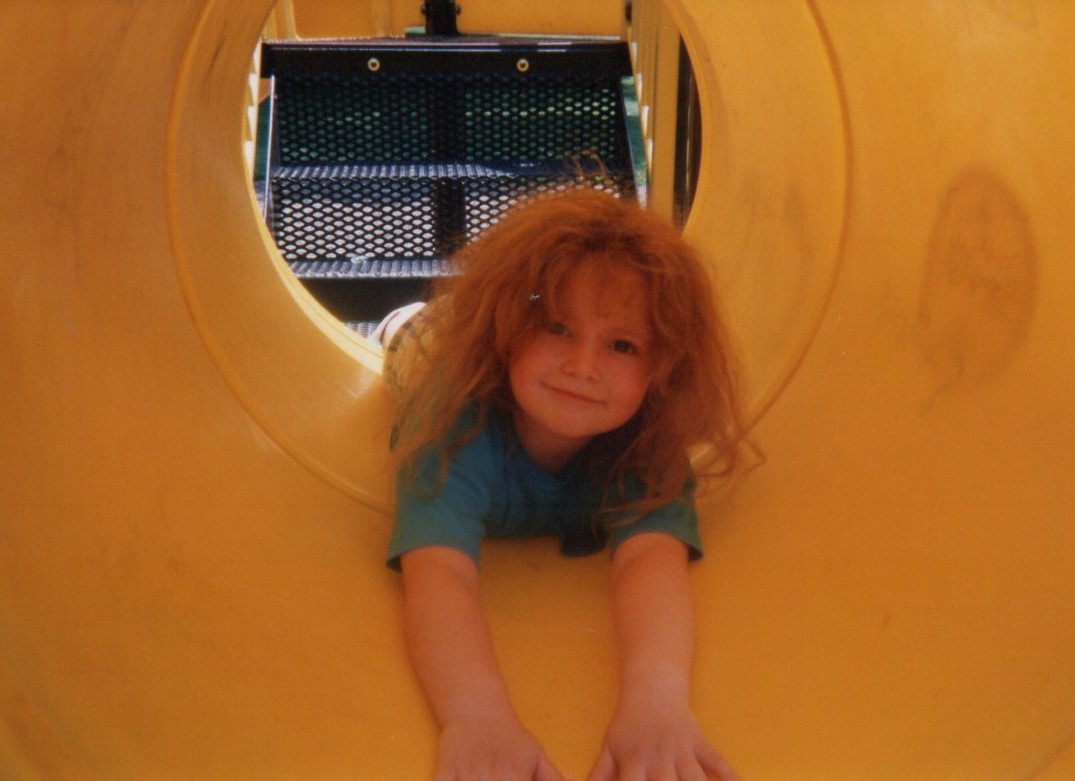
Her other friends and I have bonded over the love we still share for Sami and the positive effect she had on our lives as she encouraged us to believe in ourselves. Sami had a big heart. There was much she could not eat, but if I offered to eat somewhere else so that she would not see me eating what she could not have, she would simply say "Eat some for me!"
In true Sami fashion, the last message she ever sent me was a Pokémon meme. While she was not always herself in the year leading up to her death, I choose to remember Sami for the loving and caring friend she was. She left me a bucket one Christmas soon before she passed, filled with notes for me to read whenever I needed them.
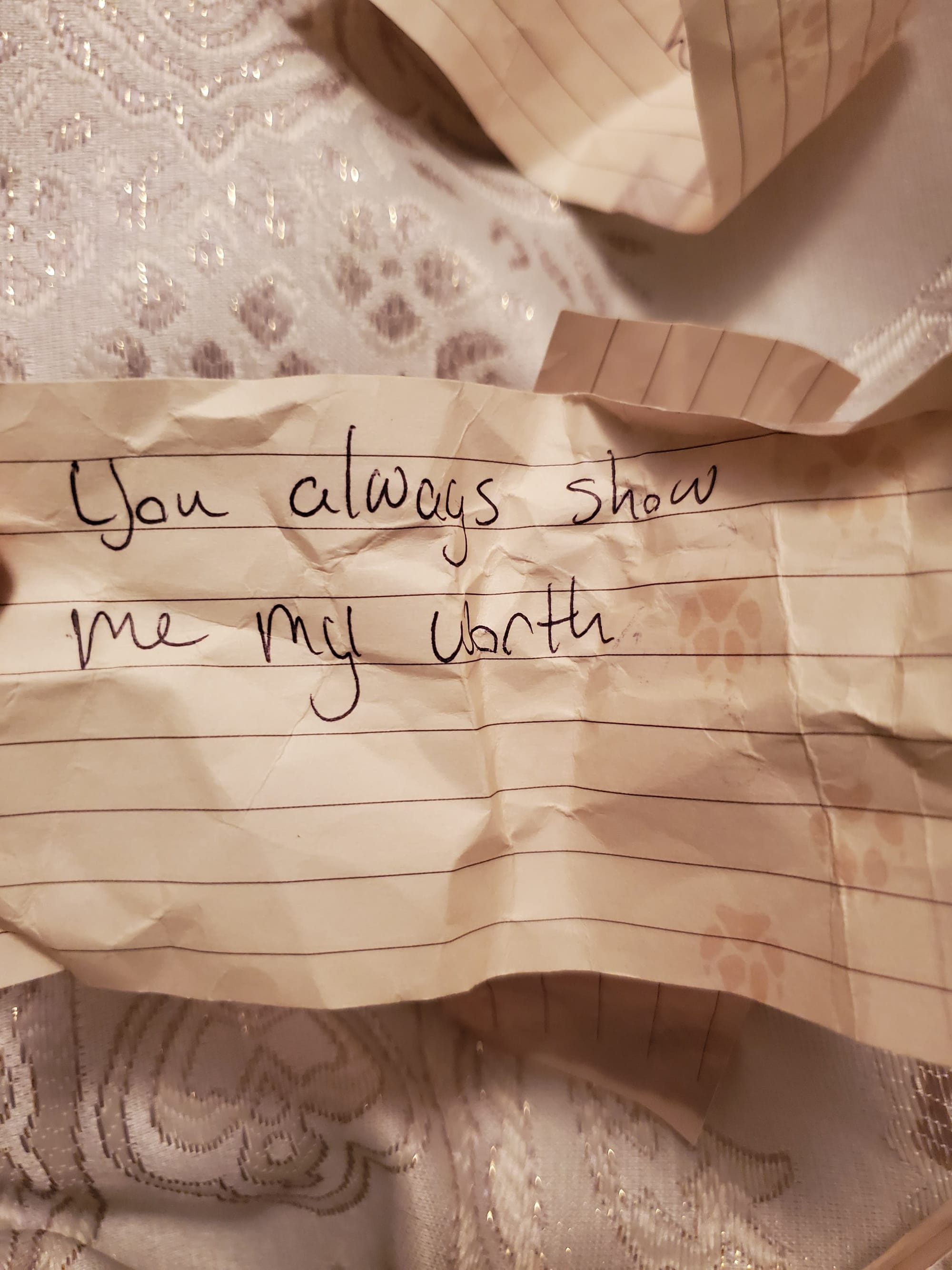
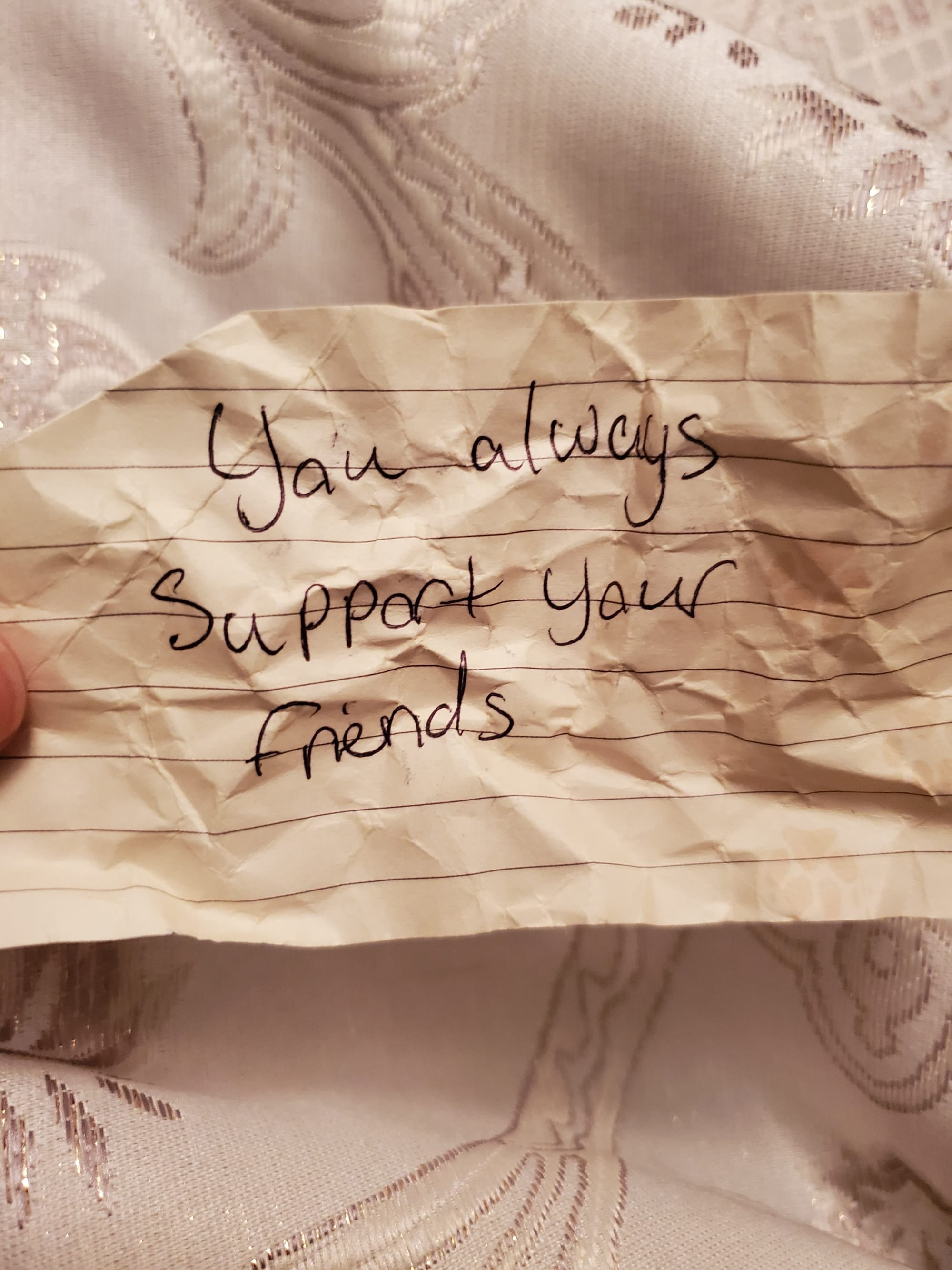
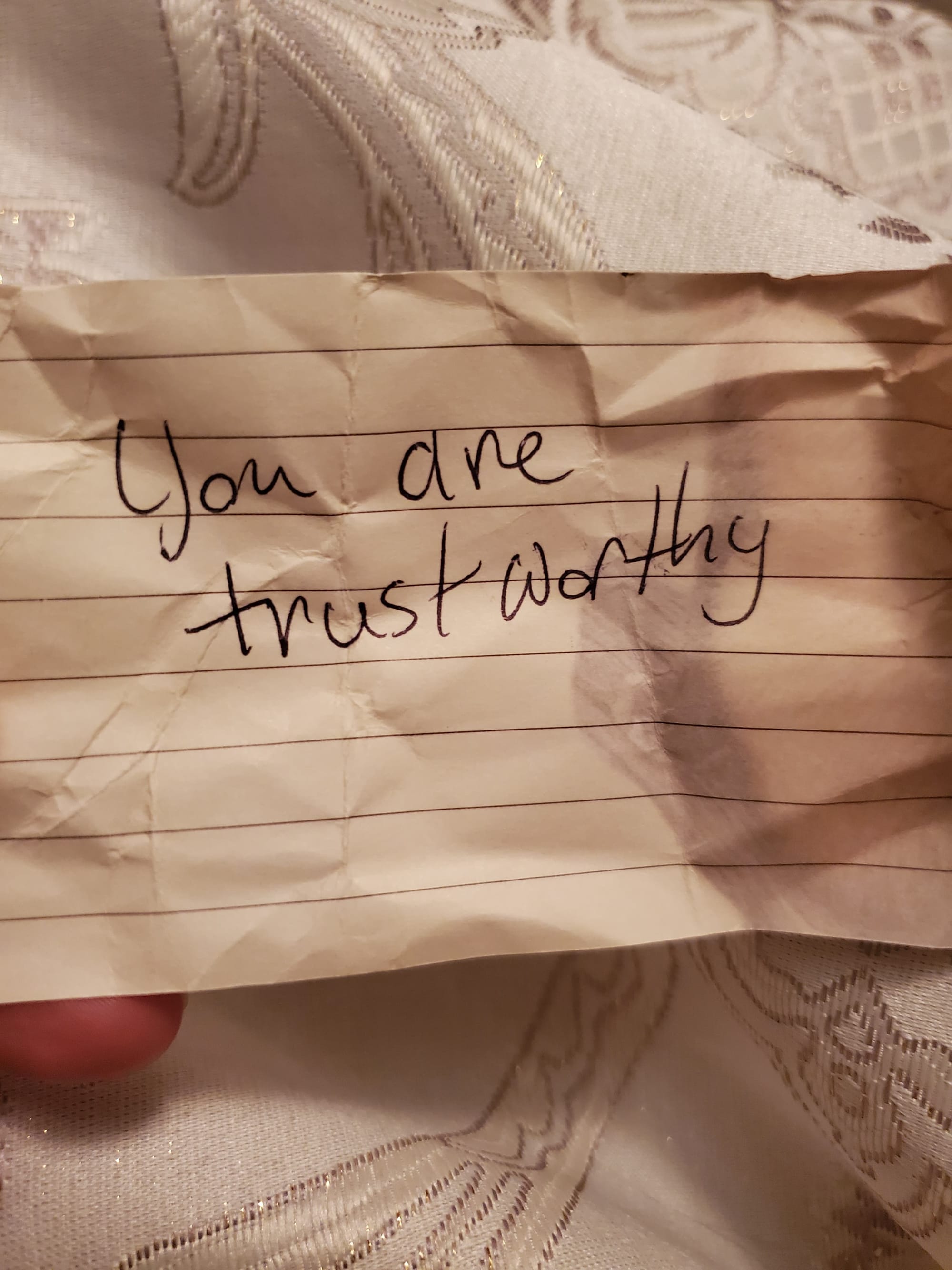
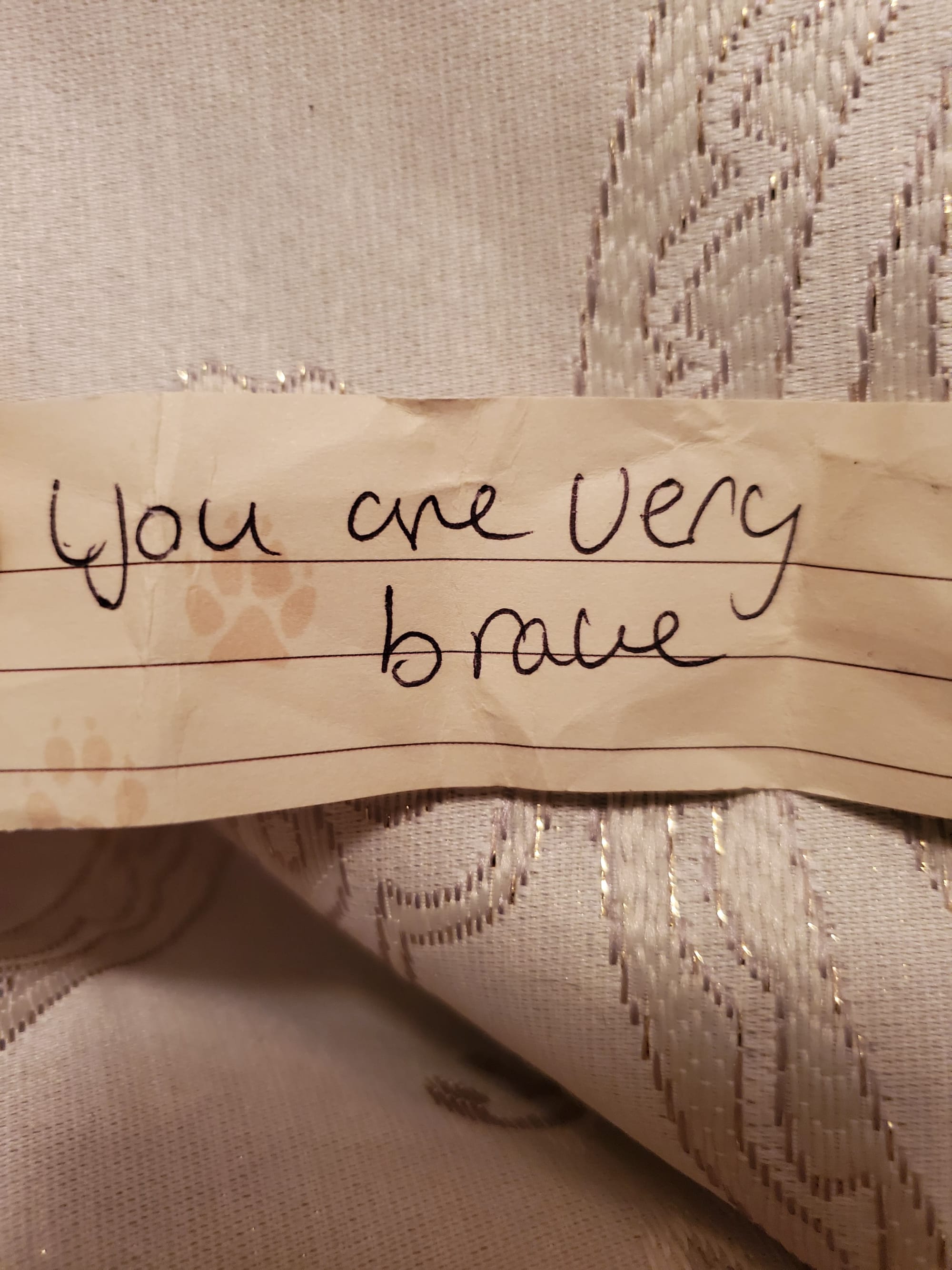
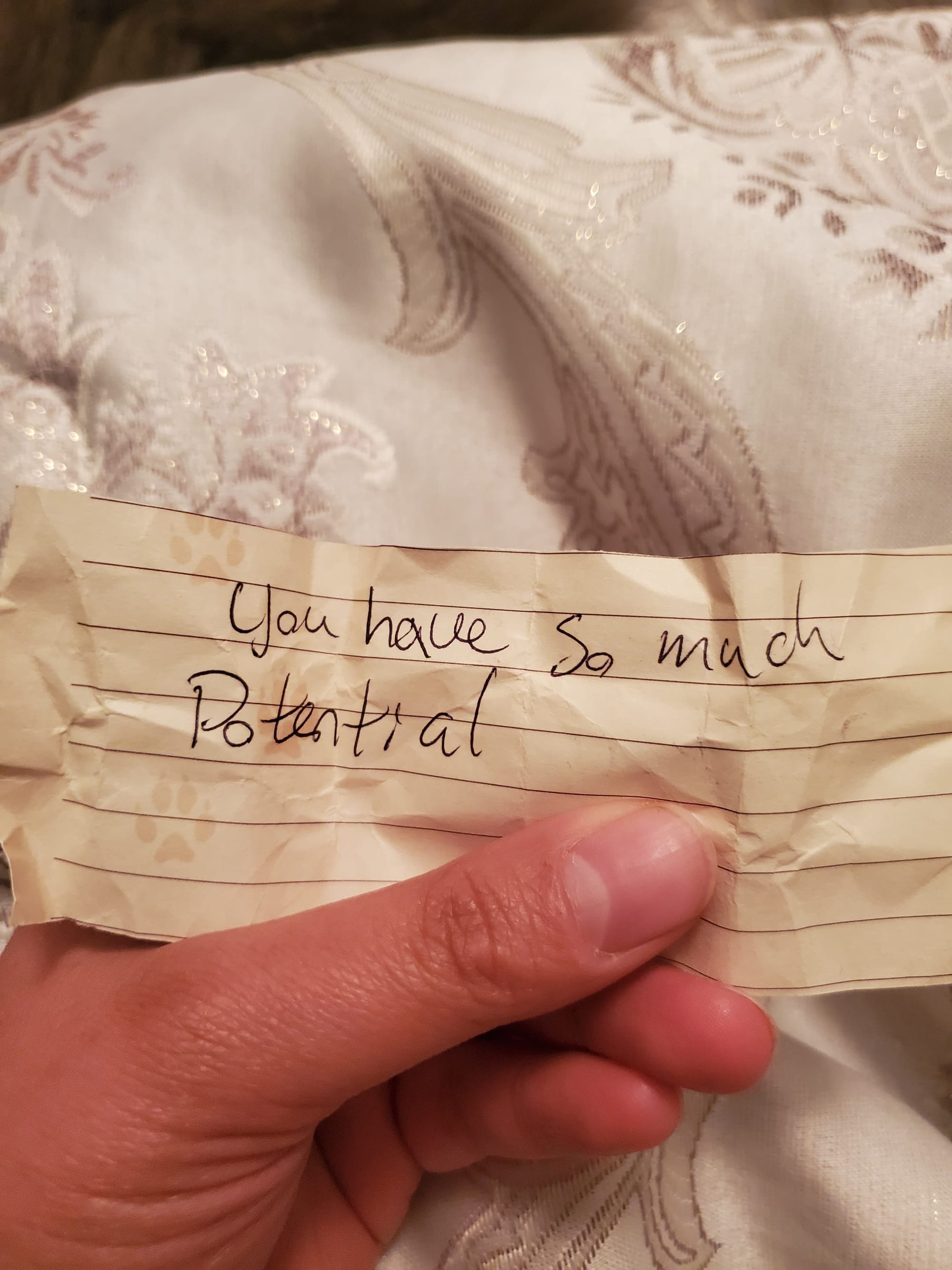
Just a few of the notes Sami wrote to me
Her friend Tabbi told me that Sami had stopped her from walking past an art gallery one day until Tabbi had gone inside and advocated to have her art on display. When I asked her to describe Sami in her own words, Tabbi said:
Sami could have left me to spiral. Instead, she made me choose. Keep down the (harmful) path I was on, and she'd see to it that I lost everything that mattered to me...or stop, and she'd make sure I still had the people that mattered...it was an offer I couldn't turn down. Because of that, I did what I could to look after her...food when I could, days out to restaurants, trinkets that reminded me of her. She joked that I took her on dates without ever dating her.
Over time, she grew protective of me in her own way like calling out people who would stare at me...she didn't let people use me even people I would have let use me...she made sure I was looked after by people in her life.
Overall, her greatest impact on my life was her belief in me and her ability to both support me and push me. She was that friend that could be painfully honest but that made me believe her when she thought me able..she got me to try..I sold my first art piece to a coffee shop, Batista. Almost got me up on a local gallery wall. Her pride in me was why I painted her things like the black and purple box or the frame for her poster. She's the only person I ever felt brave enough to do things for by hand outside of biological family.
Before chronic illness overtook her life, Sami worked multiple jobs and at one point worked to make sure all 5 or 6 of the friends she lived with could be employed at the same job together. She helped more than one friend get clean from addiction and out of homelessness. Inspired by Sami and motivated by her death, her friend Lindsey recently enrolled in school to become an emergency dispatcher and pharmacy technician.
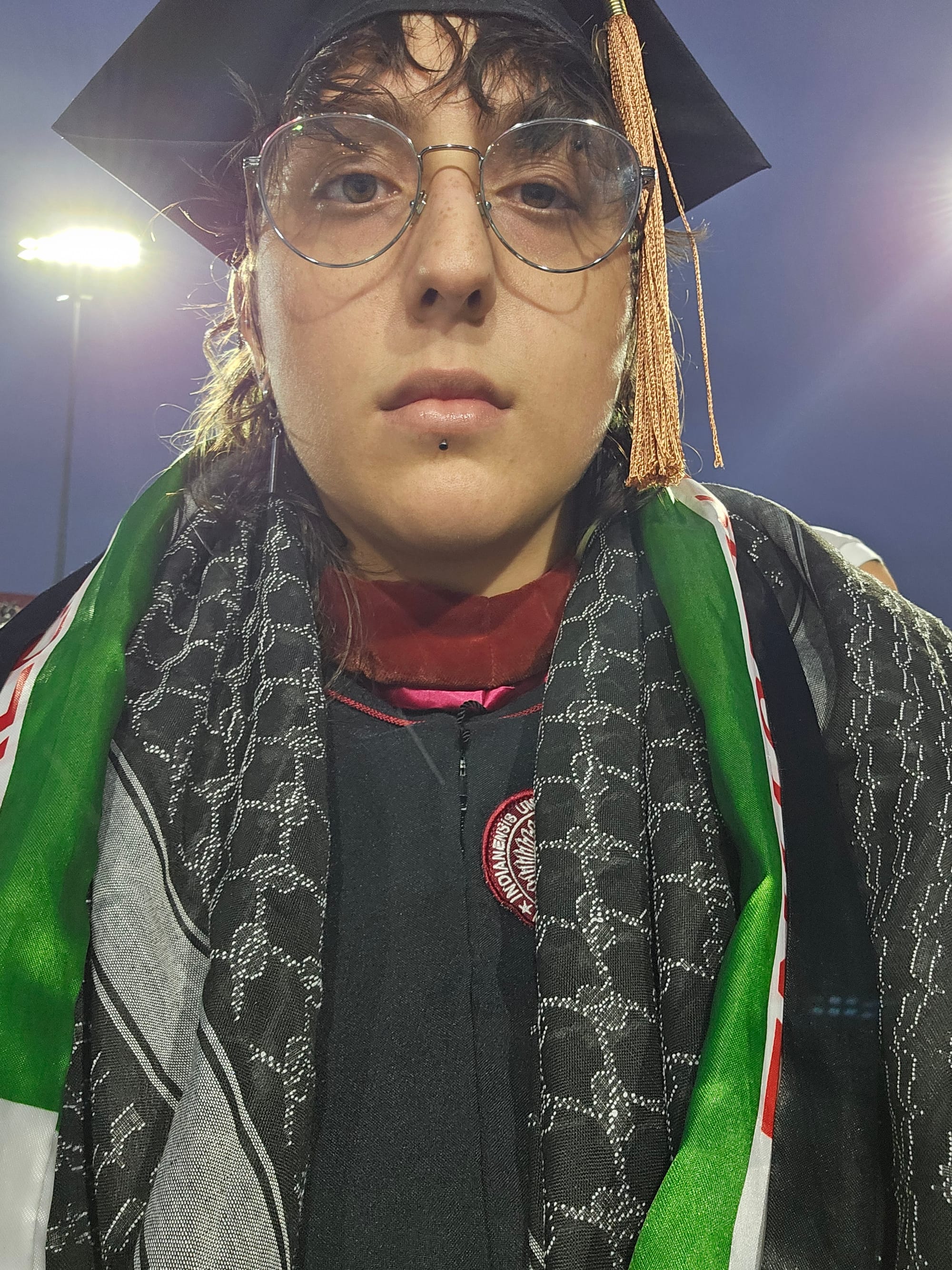
I have had the courage and strength to rebuild again and again and never give up on my own growth because of how deeply Sami believed in me. I wish she could have been at my wedding. I wish I could tell Sami that I did end up getting my master's. Despite my graduation being delayed a year and in spite of all of life's challenges so far, I never gave up. I made the decision to walk out of the graduation ceremony alone to join a protest against IU President Pamela Whitten for deploying the police to arrest the students in Dunn Meadow who were protesting genocide.
Even during times that I feel alone, I make an active choice each day to stand up for what I believe in, regardless of if there is anyone standing with me. Tired as I was, and am, I never lost my tenacity because Sami believed in me.
In my mind, Sami is always there standing beside me.
Sami is also the main reason why I am able to embrace certain parts of my own identity. The day Sami died, I called Tabbi to tell her of Sami's passing. It was during this call that she told me:
"Sami loved you, but at times she thought you were a bit too exclusionary."
Though I immediately brushed it off, that simple sentence sat with me for a long time, leaving me with a lot to unpack. It felt cruel to use Sami's death as the time to relay this sentiment to me, but it's quite possible that it would not have had the impact that it did if she hadn't.
I knew that her words stemmed from a time I spent steeped in radical feminist ideology when I made Sami feel as if I was invalidating her own identity by questioning her complicated past. It wasn't my intention that mattered.
It was a reminder that knowing is a powerful tool, but what one chooses to do with that knowledge, is, above all else, what determines the good that they do. It was a reminder that theory without ethical application will only ever cause harm. Even in her death, Sami made an impact on my life in an unforeseeable way.
She is gone, but the positive impact her life had on those who loved her will never be forgotten. I smoke from time to time these days, imagining her beside me whenever I take a hit from the case she left me. I still have to pull over if Lana Del Rey's Ride comes on the radio.
Caring for Sami was the hardest thing that I have ever done and if I had the chance, I would choose to care for her all over again. Getting to know and experience Sami was a gift.
Sami would have turned 35 this month.
Rest in peace, Player One.
-BluJay
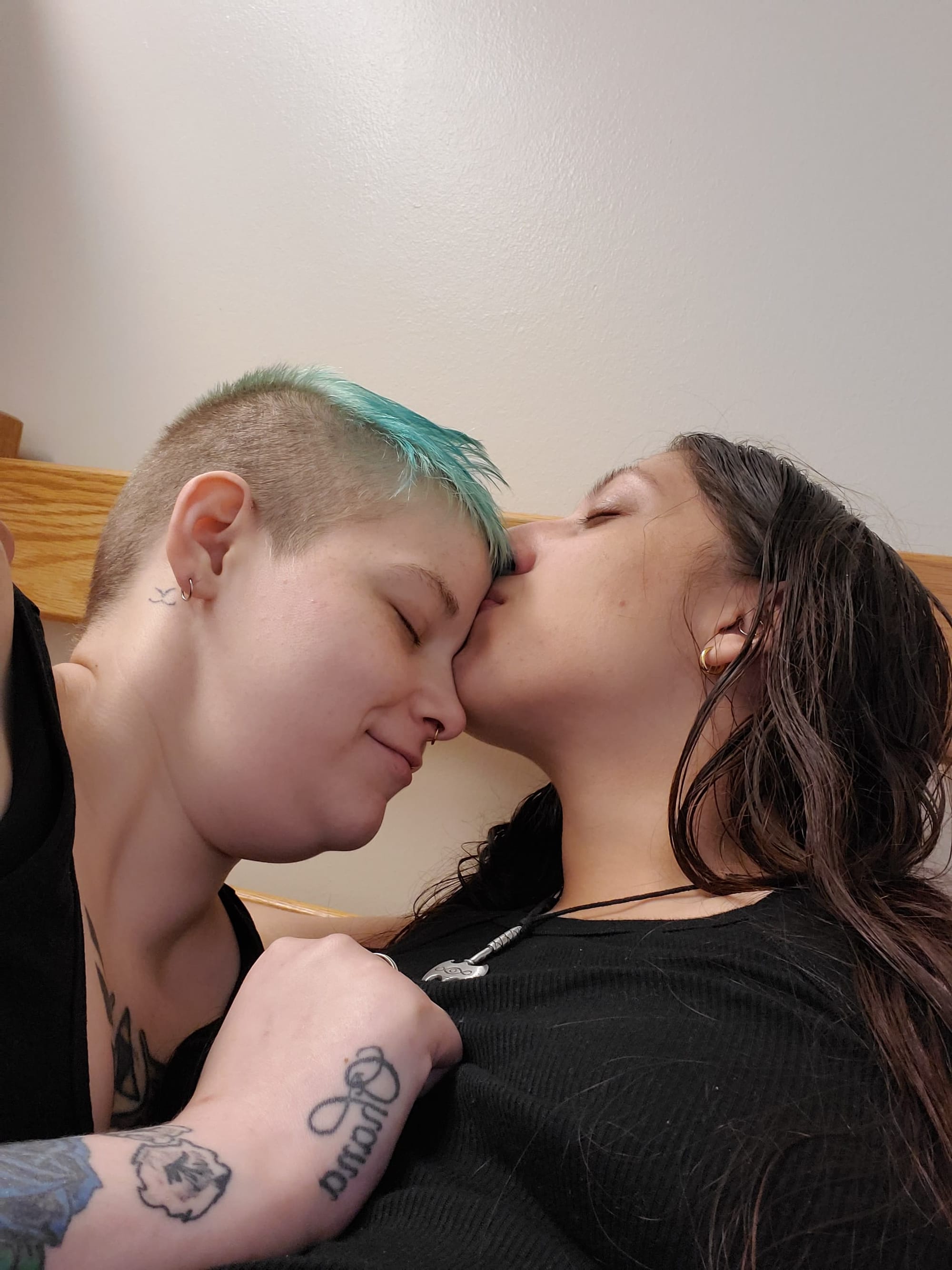
"And so it goes, you're the only one who knows." -Billy Joel
